First, the latest big core update has finished rolling out, and you’ll learn about everything that changed. Then, you’ll get a long breakdown of why SEO feels harder now, and fresh data on how well ChatGPT traffic converts.
In the next set of stories, you’ll learn what happened when one team outsourced all of its marketing to AI. You’ll also get data on how search is being remonitized, and discover why some analysts think the social media era of marketing is at its end.
At the end, you’ll get new insights from marketing pros covering, including theories on what hurts your visibility in AI results, and speculation on why Google may be intentionally wiping out top-of-funnel sites.
March 2026 Google Discover Core Update Is Done Rolling Out After 3 Weeks
https://www.seroundtable.com/february-2026-google-discover-core-update-done-41006.html
Barry Schwartz brings you this news about Google’s latest Discover Core Update. This three-week overhaul finished with major changes for sites that depend on news content and the Discover tab.
As a result of the update, local articles will be much more likely to be surfaced than those that are published in more distant regions. In particular, Google said the updates were likely to prevent non-US publishers (especially clickbaity ones) from showing up in the US.
In a statement posted after the core update, Google stated the changes were meant to show more original content from sites with expertise. This update followed a series of others that penalized spam and general websites.
You should check out the changes to the Discover documentation if you have a site in the news vertical. Also, check out the full article for discussions from top SEO communities on how these effects are being felt.
Discover isn’t the only place where the SEO game is getting harder. In the next piece, a marketing senior director discusses why everything feels harder now.
Why SEO Feels Harder Now: AI Search, Reporting Pressure, and Black Box Rankings
https://www.youtube.com/watch?v=qzUSCx_R-Wg
Vaenisaa of the AI SEO show brings you this far-reaching interview with Zach Chahalis, Senior Director of SEO and Data Analytics at iPullRank. They discuss the state of in-house SEO and why it feels tougher to get the same amount of attention from search engines.
The talk covers almost everything about the current landscape of SEO and AI. They discuss how SEO has emerged in the wake of AI’s impact and what experts think matters most now. They highlight structured data, schemas, entity mapping, and knowledge graphs as elements that have become increasingly important.
Their discussion should be very valuable to anyone who is struggling to improve the value of an in-house team or determine the talent necessary to build one the right way.
Check out the complete interview to learn more about how to do SEO right now, including the safest and most boring tactics that are still highly effective, the misconceptions about AI that can now be disproven with data, and ideas on how to explain all the changes to your clients.
Next, there’s some new research on ChatGPT traffic, and it may be far more valuable than you thought.
ChatGPT Traffic Converts 31% Better than Non-Branded Organic Search (94 eCommerce Sites Analyzed)
https://visibilitylabs.ai/chatgpt-vs-organic-search-conversion-rates/
Jeff Oxford brings you this study of 12 months of Google Analytics data from 94 eCommerce stores (7-8-figure brands generating more than $30 million in revenue).
In this massive test, Jeff and his team tracked organic and ChatGPT sessions that occurred across all tracked stores. They intentionally excluded homepage traffic and blog posts from the results. This kept the comparison focused on commercial intent.
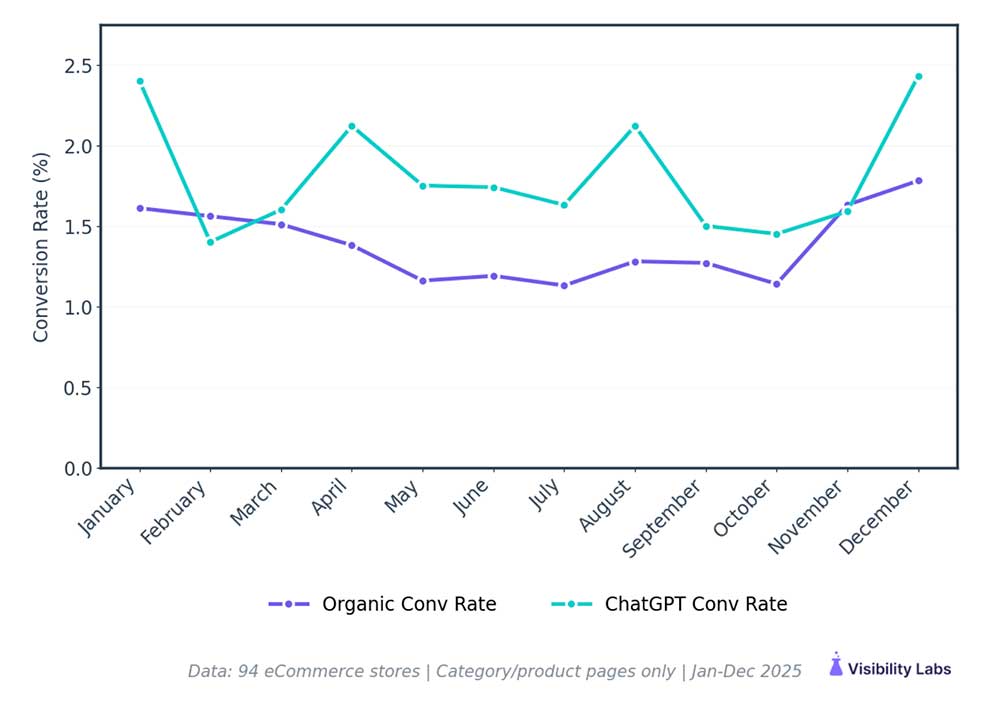
ChatGPT traffic beat organic traffic for 10 of the 12 months that the study lasted. Jeff and his team did their best to understand why. He suggests the difference appears because ChatGPT users refine their needs before clicking. ChatGPT users arrive ready to evaluate and purchase, not to browse.
Check out the complete study to learn more insights the team uncovered, including extra stats on traffic, revenue per session, average order value, and other information that could inform your next big moves.
Speaking of big moves, one team outsourced a marketing strategy to AI. In the next piece, you’ll learn what happened.
I Outsourced our Digital Marketing to AI. Here’s What Happened
https://www.youtube.com/watch?v=3iNJeArrUu4
Sam Oh brings you this look at the results when you just hand over the marketing strategy to agents. This was just a fun test, but it shows some of the amazing early potential of agents and gives you an idea of what they can really do.
For the test, Sam fed ChatGPT a year’s worth of product update blog posts. He built a custom project around the library of information he provided, wrote instructions for the bots, iterated on tone and style, and then tested the system on three deliverables that actually ship.
His team gave the agents responsibility for a product updates blog post, a YouTube script, and a newsletter that goes to tens of thousands of people. They evaluated where AI content shines for speed, where it breaks without context, and what happens when brand voice collides with generative outputs.
Sam wasn’t aiming for perfection. He planned ahead to aim for “about 80% there”. He and Tim Soulo evaluated each one based on their team’s high standards. The results were mixed. Tim was able to identify most AI examples and provided some interesting insights on how he applied standards and recognized flaws.
Check out the full video for a breakdown of how the AI performed across each content type. Are you building the right content? Search is being monetized in new ways, and the next piece can help you understand how.
Search isn’t Just Turning to AI; it’s being Re-Monetized: Text Ads Are Taking a Bigger Share of Google SERP Clicks (Data)
https://www.aleydasolis.com/en/search-engine-optimization/serp-shifts-ads-remonetized/
Aleyda Solis brings you this look at where the money in search is really going. While AI is often blamed, she argues that another cause lies in the data.
Her hypothesis was that the increase in text ads (as well as organic SERP features) could also be responsible for the decrease in classic organic search clicks across different verticals, potentially even more so than AIOs.
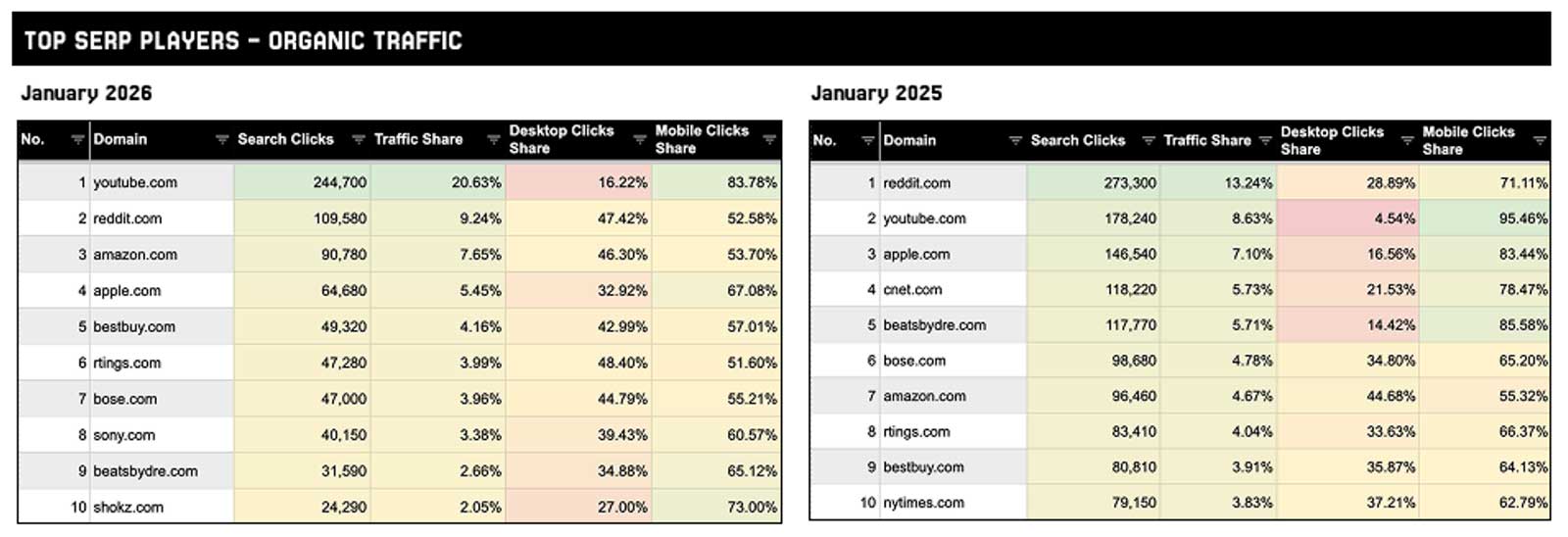
She used Similarweb data to analyze the SERP composition evolution across four verticals. She chose the top 5,000 queries for headphones, jeans, and online games (plus the top 956 queries for greeting cards & ecards in the US).
For each vertical, she tracked click distribution for classic organic results, organic SERP features, text ads, PLAs, zero-click searches, and AI Overviews.
In every vertical, she discovered major shifts. For example, in just headphones, she found that classic organic click share dropped from 73% to 50%. This was a 23% decline in a single year. She also discovered that:
 Text Ads rose from 3% to 16% (+13pp) and PLAs from 13% to 20% (+7pp).
- PLAs also grew from 13% to 20%. Combined, paid results (text ads + PLAs) now capture 36% of clicks, up from 16%, more than doubling in one year.
- Zero-click searches remained stable at 63%.
- AIO’s presence on SERPs exploded from 2.28% to 32.76%.
She breaks down who appears to be benefiting most from these changes in each vertical. For example, with headphones, she found that YouTube is the big winner. It jumped from #2 (178K clicks) to #1 (244K).
Check out the complete article to get data and analysis for all four of the verticals she covered in her research. You’ll also find a lot more about who is winning and losing organic traffic, and who is buying these clicks. Next up, a social media marketer predicts the end of social media.
AI is Ending the Social Media Era and What Comes Next
https://www.youtube.com/watch?v=sUvWVF28CNM
Sinead Bovell interviews and debates Gary Vee about the possible end of the social media era from the perspectives of creators who need to reach an audience. Their talk covers why social media marketers are saying the end is near, how pros are adapting to AI, and more.
Both hosts agree that one of the biggest changes (AI) is here to stay. They acknowledge some struggles with AI creator tools but agree that new technologies are always clumsy before they transform everything.
They also cover some trends that may doom social media. For example, they discuss how younger consumers’ habits are changing, turning away from social media toward real-life experiences or personality-led spaces online.
The news isn’t all bad for creators who depend on social media. The host and guest have a lot to say about how brands and creators can continue to break through in a new AI-driven economy. They also speculate on the future of entertainment after social media and how creators can start crafting more immersive experiences.
Check out the full video for a spirited discussion about what comes next and how creators should be preparing. If your future visibility depends on AI, you may be making some mistakes you can fix. The next guide will take you through them.
5 Mistakes Hurting Your AI Visibility (With Data-Backed Fixes!)
https://www.youtube.com/watch?v=CDYq5xlaROY
Matt Kenyon brings you this look at some of the simple mistakes that can make AI ignore you. You don’t need to abandon SEO or chase “secret” AI SEO/GEO/AEO tactics, he argues. Instead, AI visibility comes from solid SEO fundamentals with more intention and better data.
First, he comes out strongly against diverting your resources from traditional SEO to get more attention. As he points out, all AI models have been shown to prefer information that’s already ranking well, and even prefer Google’s best ranking results as a source.
That means any effort you cut from SEO could harm your AI visibility as well.
There’s much more advice in the complete video. He discusses why refusing to talk about your competitors can make AI ignore you, why chasing AI visibility data often leads to bad outcomes, and why you shouldn’t ask AI how to rank in AI.
In the final piece of the month, Google is accused of wiping out top-of-funnel sites. Find out why one SEO is making this accusation.
Unconfirmed Google Update Wiping Out Top of Funnel Sites (Here’s What’s Surviving) Edward Sturm
https://www.youtube.com/watch?v=ujURQ6FwrqM
Edward Sturm brings you this look at major volatility and a possible Google update that passed through last month. While this disruption was tracked across many tools, Google refused to confirm or explain the source. Edward tracks the chatter and shows his own data to try to figure out what happened.
First, the SEO community noticed these changes early and had nothing good to say. In the video, Edward covers multiple cases in which site owners reported a total collapse in traffic or engagement due to the mysterious shifts.
According to Edward, these events were not explained by the Discover core update that you learned about above. This was a different system at work, and it was targeting listicles and top-of-funnel (informational) sites.
Edward shares some of his personal data, showing that his top-of-funnel pages were hit hardest. At the same time, his bottom-of-funnel sites remained unaffected, along with some supporting data from other SEOs.
Check out the full video to learn more about this strange event and what it may mean for future updates, and keep checking our roundups for the latest marketing news. If there are big changes, you’ll find them here first!


