
Stay ahead of the pack with the latest news on every kind of online marketing. Here, you’ll find all the latest stories you shouldn’t miss from late June and early July.
First, you’ll learn how one marketer taught AI to recommend any brand. Then, you’ll learn how some affiliate sites are surviving and even thriving after being crushed by Google and what sites are being targeted by June’s brutal Spam Update.
After that, you’ll get insider knowledge about YouTube’s algorithm, review a new AI ad agent announcement from Google, and explore the latest AI search loophole and whether it really works.
At the end, you’ll learn how ChatGPT cites sources based on a new case study, why Google may be paying more than a billion dollars to Klarna, and what the case may mean for the future of search.
TRAIN Any AI To Recommend You
(This Study Proves How)
https://www.youtube.com/watch?v=Yp03WwNrk9c
Caleb Ulku brings you this look at what to do when ChatGPT won’t recommend your local brand or business, and doesn’t even seem to know who you are. He argues that internet marketers are approaching this problem from the wrong angle and that he’s discovered a better approach.
He reminds viewers that LLMs do not operate as a giant web of topics like Google. The initial training data is limited, and additional information is gathered at the moment of the query. If your brand isn’t already easily searchable, an LLM may not even detect that you exist.
Caleb argues that it’s possible to not only become more searchable by LLMs but also bake your brand name directly into the permanent training data. Recent research has shown that only a few hundred mentions can permanently influence recommendations, even on major LLMs.
He recommends starting this process with an audit, provides helpful instructions with only a few prompts, and even shows you his own process for interpreting AI audit results. From there, he goes in-depth on how to build permanent AI authority and what content you need.
Check out his complete video guide to start training AI to recognize your local brand. Next, you’ll learn how one marketer recovered from having his affiliate websites nearly crushed. It turned out the path to recovery wasn’t through Google.
Google Crushed Affiliate Websites. His Grew Anyway
https://www.youtube.com/watch?v=Sk8MAbD39Qw
The Ahrefs team brings you this look at one of the few affiliate owners who is thriving after recent updates, and how he protected his business despite all the updates. The interview subject is Bryon Powell, the owner of the running blog iRunFar, which has been operating for almost 20 years.
Like many blogs, iRunFar built a massive amount of site content in the 2010s, not always in the most valuable ways. Unlike many blogs, they reacted immediately when they started to see their traffic and position plummet.
Byron set out to sharpen the site’s content. He rewrote many of his site’s guides and reviews, focusing on rebuilding his audience’s trust. He also removed many pieces of content that were low-quality or outside the website’s focus.
Byron now treats each page as part of his portfolio. He personally monitors the performance of all of his best guides and adjusts them by hand whenever their performance changes. His reward for this campaign has been almost 200% growth.
The Ahrefs team has some more analysis for him. Check out the full video to learn how they project his affiliate business could grow faster with the right missing content. Next, some sites aren’t recovering from updates, particularly those hit by the latest spam update.
Google’s June Spam Update Is Brutal:
The Sites Getting Wiped Out And Why
https://www.youtube.com/watch?v=x981_vBN5W4
Edward Sturm brings you this look at the aftermath of the latest spam update Google rolled out on June 24th and finished on June 26th. He reviews some of the SEO community chatter, assesses the winners and losers, and offers some theories on the goals.
First, this update may have been tested for a long time. Edward found multiple posts from SEOs reporting concerning changes to SaaS and news site traffic in the weeks before the update was launched. There was also volatility afterward.
A fresh note in Google’s Spam Policy now clarifies that LLM answer manipulation is a new form of recognized spam that can result in a site penalty. This new passage led many SEOs to ask if the targets of this update were believed to be violating that policy.
Check out the complete video for more analysis on the update, including the top parasite SEO platforms and why Reddit, Substack, Yelp, and other sites are being used for parasite SEO. Next, an ex-YouTube employee breaks down the algorithm in a recent interview.
Ex-YouTube Employee Explains the Algorithm
https://www.youtube.com/watch?v=VpKYkZr-1oQ
The Gimbal Podcast brings you this interview with Nastia Debowska, a Content Strategist and former YouTube Partner Manager. She discusses some of the things she learned behind the scenes at YT, and shares her perspective on why videos flop, how the algorithm works, and more.
They start by exploring why videos flop. Nastia talks about the exact metrics she checks whenever a video doesn’t go well, and about several ways you can set your videos up to fail by misunderstanding your audience and making other mistakes.
Nastia also talks about her experience as a partner manager. She talks about how managers are trained by YouTube and taught to use data to give better advice to partners. She also discusses how she often helped creators identify engagement patterns to build better new content.
The interview also covers some of YouTube’s new features and whether taking advantage of them will make YouTube treat your content more favorably. They discuss what it takes to be assigned a partner manager and why the process remains so secretive.
Check out the complete video to learn more about promoting videos on YouTube. Next, Google is announcing a new AI agent that’s embedded directly into Ad Manager. Learn what it can do and when you can start putting it to the test.
Introducing Ask Ad Manager, the AI Agent That Will Help You Get More
https://blog.google/products/admanager/ask-ad-manager/
Google brings you this quick announcement covering the arrival of its new ad agent. The agent, named Ad Manager, is built on Gemini and designed to provide conversational insights to speed ad decisions.
According to the announcement, the agent will be able to access your data to provide personalized answers and recommendations. Google recommends taking advantage of these new features to troubleshoot in real time, navigate more easily, or monitor your performance with a single prompt.
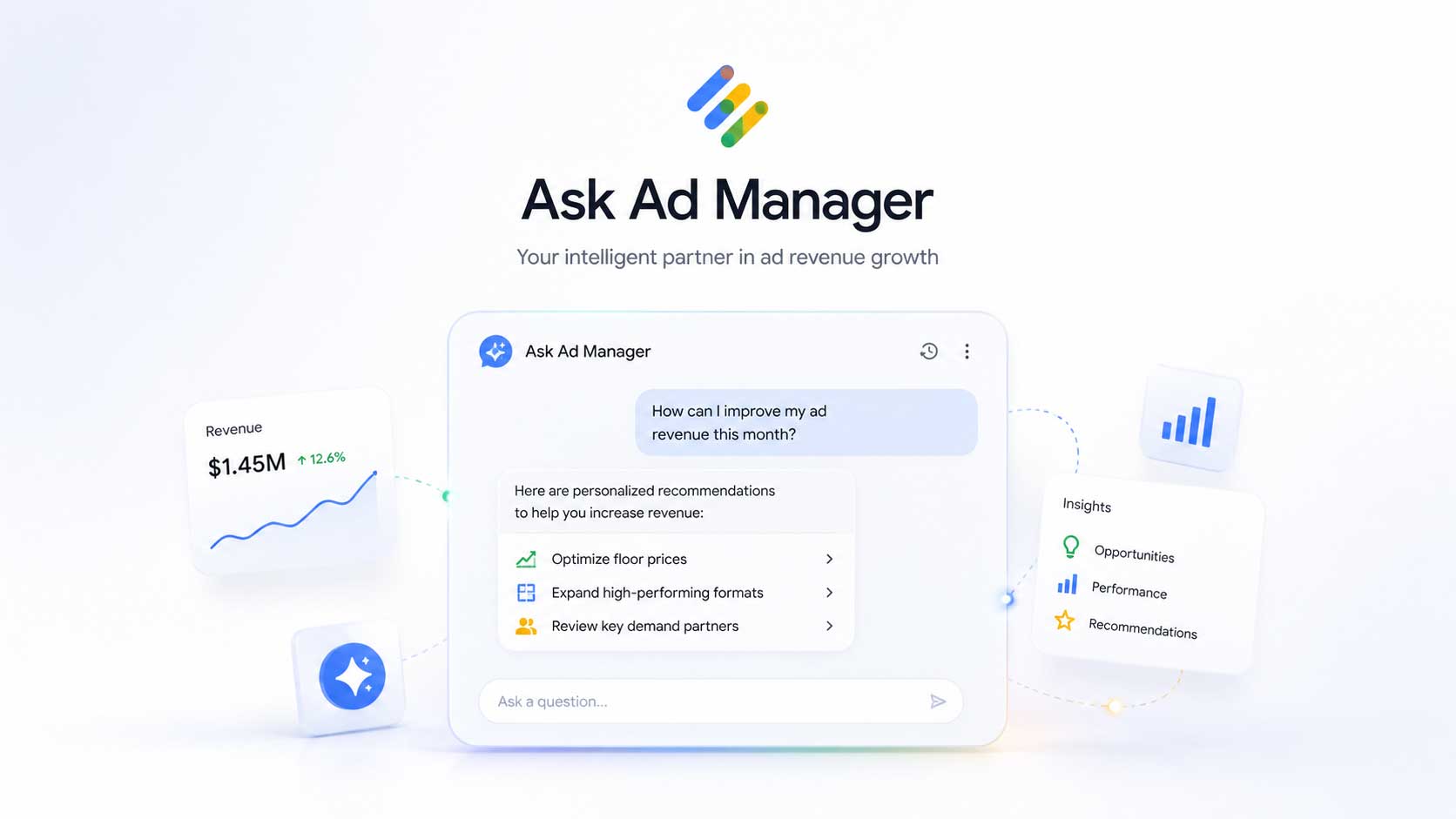
This is just the beginning, the announcement continues. To make these integrations even easier, Google will release new developer tools later this year (REST APIs and an MCP server) to support key trafficking workflows.
They’re also developing specialized agents for publishers and agencies so you can more efficiently discover, negotiate, and execute campaigns directly from the platform. This is part of a growing infrastructure that enables first- and third-party agents to interact at scale.
Next, I’m putting one of the latest AI search loopholes to the test. Learn more about my results and what they told me about getting recommendations from AI.
The Latest AI Search Loophole… Does It Actually Work?
https://www.youtube.com/watch?v=fHuomy6gAOA
I bring you this look at my most recent LLM test, which covers a new loophole you can use to earn LLM attention.
The last notable loophole was that LLMs seemed compelled to cite domains that generated enough mentions across the web in listicles. As long as you could force enough mentions, you were almost certain to be cited. It’s not as easy now, but there’s still one method that works.
You use the new loophole by taking advantage of the fact that LLMs are highly tuned to favor the most authoritative news sites. In fact, they are much more likely to cite these sources for any information about you than they are to cite your website content.
It’s possible to get mentioned by these huge authoritative sites, but you need digital PR. This is a remarkably simple strategy when you get down to it. I break down how to build a campaign from scratch, gatecrash the site’s AI tools trust, and then turn the coverage into revenue.
Check out the full video for my complete list of steps, including how to follow up on your success. You’ll also get to see a real example of how this worked for one of my clients. Next, you’ll explore more fresh data, this time about how citations work across ChatGPT’s different modes.
Only 25% of Cited Sources Overlap Between Chatgpt’s Different Reasoning Modes [Study]
https://www.semrush.com/blog/chatgpt-reasoning-ai-visibility/
SEMrush brings you this study exploring the behavior of ChatGPT’s reasoning modes. The authors argue that ChatGPT operates in both low- and high-reasoning modes. Critically, they discovered that it behaves significantly differently depending on the mode that it’s in.
The team found that when ChatGPT used higher-level reasoning, it behaved like a different search engine. Across repeated tests, only 25.6% of cited domains overlapped between minimal and high reasoning for the same prompts. Nearly 3/4 of the cited sources are different.

They also discovered that citation behavior changes as soon as higher reasoning is turned on. When the research team compared low- and high-reasoning groups, the citation rate jumped from 50% to 68%, and the sources per response nearly doubled.
There seem to be clear patterns in how citations change. For example, Reddit and other user-generated content (UGC) sites lose roughly half their share of citations in Thinking mode compared to Instant mode. They are replaced by government, academic, and official documentation sites.
Check out the complete study to find out more about what was revealed. They cover who is most affected by changes in reasoning and why top-of-funnel content is especially valuable in higher-reasoning modes. Next, you’ll learn about Google’s latest court battle.
Swedish Court Orders Google to Pay $1.5 Billion to Klarna in Antitrust Damages
Reuters brings you this look at a recent Swedish court judgment against Google for unfair trade practices. Google is ordered to pay more than $1 billion for unfairly promoting its own shopping service in results.
This dispute dates back to 2008, when Google began giving its own comparison shopping service a more prominent place in search results. Traffic to rival price comparison sites fell sharply, and the sites that were hit began filing cases with the European Competition Commission and other bodies.
Google has lost several cases against other shopping comparison services, including, most recently, to PriceRunner. Other site owners are filing compensation claims in the UK and Italy.
A Google spokesperson said the company has made changes to its shopping advertisements since 2017 that have been working well. Internet marketers involved in comparison shopping niches may not see immediate changes. This decision is eligible for appeal, and it may take many years to be fully resolved.
That’s all for this month’s roundup. Come back next week to find the top news, guides, case studies, and more in the world of online marketing.


