Welcome back to another big roundup of the latest news in online marketing. I’ve pulled together some of the biggest headlines from the last month, covering SEO, LLMs, paid ads, social media marketing, and more, and there’s plenty here that you shouldn’t miss.
In the top stories for the month, you’ll find out what happened with the latest Spam Update and how publishers are responding. Next, a top SEO argues you’ve been lied to about AI content (and has data to prove it), and another has discovered a trick for building out AI directories.
There’s plenty more news after that. OpenAI has made a major announcement about its paid ads, with many clues about the future. Then, you’ll learn a technique for reviving a dead website and get some tips for mastering Facebook’s updated Ads Manager.
At the end, there is a series of major updates about Google and its future. Their AI Overviews are carrying way more links, and they’re facing significant damages in a monopoly case over their ad technology.
Google’s September 2026 Spam Update Is Here (And It Came With a Secret AI Spam Detector)
https://www.youtube.com/watch?v=EkgJQlWtyFI
Edward Sturm brings you this look at Google’s September 2026 spam update. This update began rolling out toward the very end of September and was finished just long enough for SEOs to start sifting through the data.
As Edward points out, this was a sizable update that registered a 9.4/10 on Semrush’s volatility tracker and took nearly two weeks to complete. It’s clear that a lot has changed, and a paper published just before the update may offer some clues.
He directs your attention to a Google research paper on a system called SAFE (Scaled Abuse Forensic Examiner), which has been circulating in the SEO industry. He explores whether and why the timing of the two events may be related.
Google won’t confirm that the paper and the update are connected, but the research they’ve released suggests that this technology is being actively explored and improved.
Edward takes you through this paper and examines how SAFE may be used in the future to analyze content, behavior, infrastructure, relationships, and other factors relating to content producers. He argues that custom AI agents may already be deployed to track synthetic abuse.
Check out the complete video to learn more about what Edward found. You’ll explore some of the latest research, hear from SEOs across X and Reddit, and get some ideas on what you can do if this update hits your sites. Next, an SEO confronts whether the promises on AI have been kept.
They Lied About AI Content (This Proves It)
https://www.youtube.com/watch?v=29Kg0uYs4cI
Caleb Ulku brings you this look at whether Google is showing the neutrality toward AI content that it implied it would. He argues that Google is going after AI-generated content, and anyone who depends on content needs to understand the danger of a delayed drop that may result.
He starts with a study from earlier this year in which Lily Ray tracked the rise (and the statistically likely fall) of more than 220 sites selected from AI content vendors. Her research revealed that AI-generated content tends to grow quickly and then fall off.
Not only did pages seem destined to hit a cliff, but many of them hit the cliff within 3-6 months of being published. The shape this sharp rise-and-fall created when graphed to a chart led Glenn Gabe to coin the term “Mount AI” to describe it.
He refreshes you on some of the messaging on content that has been part of Google’s Scaled Content Abuse Policy, Helpful Content Update, and recent Core Updates. Using this background, he lays out the differences between AI-generated pages that survive and those that don’t.
Caleb also covers Claude’s recent decision to start watermarking all content. He explores whether this is another factor that will be used to identify and penalize AI content in the future.
Check out the full video for even more about the future of AI content. You’ll learn what pages are most likely to be affected by delayed drops, how to perform reproducibility tests, and how to build non-violating content. Next, you’ll learn a fresh way to get new AI directories out fast.
How to Build AI Directories on Easy Mode
https://www.youtube.com/watch?v=DzphMeAUJuo
Jesse Cunningham brings you this look at how to build directories fast using the AI tools that are now available to you. He uses directories to power microsites, but the process he describes can support your online marketing in many ways.
As he points out early in the video, building out usable directories used to mean hand-building and filling hundreds to thousands of pages. Now, that work can be done in just hours, giving you a powerful tool for your active plans.
Jesse guides you through his own 7-step process that involves:
1. Finding an appropriate niche
2. Scraping Google Maps for data
3. Cleaning the rows of scraped data
4. Enriching the existing information
5. Generating new pages
6. Ranking with links
7. Monetizing the directory
He demonstrates how to complete each of these steps in detail so you can easily follow along. He names the tools he uses, describes the kind of content he prefers to build, and covers some of the challenges that you may face getting to launch.
He also goes into more detail about what’s possible when you’re ready to monetize. You’ll learn how display ads, featured listings, leads, and even your own services can be turned into monthly income.
Check out his complete guide to building your next directory at record-breaking speed. Next, OpenAI has released a major announcement about the future of advertising on their platform, which you won’t want to miss.
(Announcement) Reimagining advertising with AI
https://openai.com/index/reimagining-advertising-with-ai/
The OpenAI team brings you a series of announcements about how ads are changing on their platform. This packed release includes all-new details covering:
 Sponsored Agents (which let people start a conversation with a business-sponsored agent after clicking an ad in ChatGPT) are now being tested
- How you can create ads by simply writing a few prompts in ChatGPT
- How Ads Manager has been made more powerful with new AI creative tools.
- New integrations with HubSpot and Shopify
The new sponsored agents now being tested with select advertisers in the United States are designed to help users go deeper, with input from a branded voice. The announcement provides more detail on how the feature works for both advertisers and users. They explain:
OpenAI argues that this new feature will make it easier for users to understand whether a product or service is the right fit. For now, the Sponsored Agent is distinct from ChatGPT’s independent answers and separate from the original conversation that the user started.

Next, the announcement covers new tools that make it easier for advertisers to use AI for ad management. With the new changes, advertisers can now use simple, natural-language prompts to create and update campaigns directly in ChatGPT using the Ads Manager plugin.
Additionally, all advertisers can now opt in to AI-powered text customization. If you enable this feature, existing headlines and descriptions will be adjusted to better fit the conversation context in a user’s preferred language!
Check out the complete announcement for more information about the changes and new tools. Next, just in time for Halloween, an SEO brings you this tale of how he brought a dead website back to life.
How I Revived a Dead Website & Now it Ranks #1 on Google & ChatGPT
https://www.youtube.com/watch?v=NXryn3EVcqg
Nico takes you through his project to revive a dead website. He starts with a one-page site with no technical SEO, featuring every service crammed together, and it has been confirmed as completely invisible to Google and every AI search engine.
This unfortunate page becomes the case study for Nico’s 5-step method. Though the following steps sound deceptively simple, he shows you clearly in the video how following them can put a site back on the path to profitability.
- Identify the most immediate problems.
- Plan fixes targeted for zero-visibility sites
- Make the changes
- Resubmit the site to Google and Bing
- Track the results
In the first step, he takes you through all the things that can go wrong with a site, leaving it with no presence after (potentially) years of operation. In several examples, he goes through the problems that plague many sites and explains how they can present opportunities.
He provides you with all of the AI prompts that he uses to diagnose the most serious problems posed by unsuccessful small websites, so that you can follow along or even start applying them to your own websites immediately.
You’ll also be provided with some checklists to carry you through the second step. The elaborate “Launch Checklist” included in the video will allow you to target the most common major problems without spending too much time on diagnosis.
Check out the complete video to understand all the steps and take advantage of the free resources provided. Next, an experienced ad manager has some tips on how to make the most of Facebook’s recently updated platform.
How to Master Facebook Ads Manager Without Wasting Money (Full Walkthrough)
https://www.youtube.com/watch?v=kcT7sSdyKWI
Karl-Friedrich Verna brings you this look at how Facebook Ads Manager changed in 2026 and breaks down what you’ll need to do to run your campaigns the right way from now on.
He introduces you to Meta’s new Andromeda AI system and takes you through his personal process for creating campaigns that don’t waste your money. You’ll learn how the new changes affect targeting, find out which settings you can safely ignore, and see examples of new campaigns.
First, he takes you through everything that has changed. Creative assets are now far more important. You no longer define an audience for your ads; instead, the algorithm does. Your targeting inputs are now suggestions rather than rules that the manager must follow.
It may be helpful to understand what you can ignore, so he also takes you through that list. Many of the features in the new ad manager, he notes, are for some of the largest budgets. You can safely ignore Detailed Interest Targeting, Placements, Bid Strategy, and Multiple Ad sets until you’re more familiar or working with more money.
Karl-Friedrich also covers how to build your ad creative and the simple 10-minute process he uses to start new campaigns. Check out the complete video for more, including some tips on understanding and reading your results.
Coming up next, Google AI overviews have been spotted using way more external links.
Google AI Overviews With Way More External Links; Report
https://www.seroundtable.com/google-ai-overviews-more-external-links-42135.html
Barry Schwartz brings you this fast report with possibly huge implications. Over the past month or so, Google has gone from providing external links in almost none of its AI overviews to showing them in approximately 25% of its AI overviews.
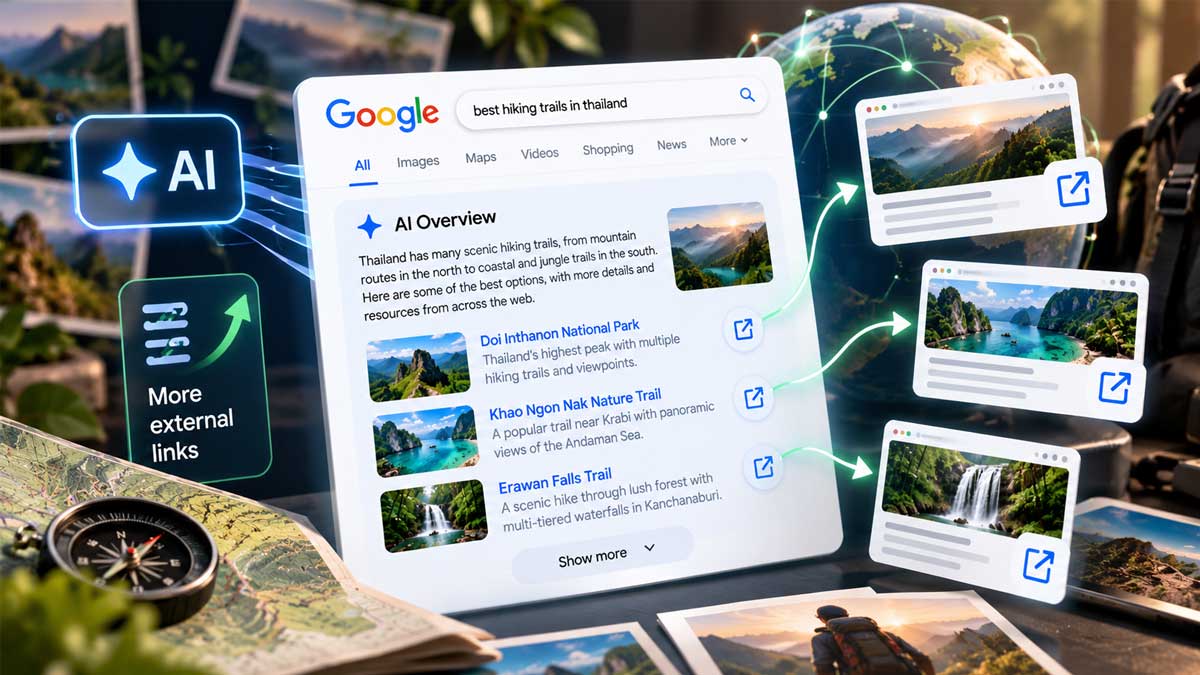
X user Malte Landwehr picked up this trend, and Barry includes his original post on the phenomenon. Barry is skeptical that this indicates any policy change and reminds you that years of tracking have shown Google to be less likely to link out.
Google has not yet explained what this change is intended to do, but it may point to better opportunities for publishers down the line. Next, Google is facing.
Google Could Face $3.2B In Damages Over Ad-Tech Monopoly, Federal Judge Rules
https://finance.yahoo.com/media-advertising/articles/google-could-face-3-2b-191307968.html
Yahoo! Finance brings you this look at one of the biggest fights between Google and the publishers who work on its many platforms. As the reporting reveals, Google currently faces over $3.2 billion in damage demands.
The claims have been submitted by major media outlets and a class of about 5,000 publishers over its ad exchange practices. They allege that Google has sought monopolization of the digital advertising market.

A judge has now ruled that Google can face jury trials that may cost the company more than $3.2 billion. The Judge rejected Google’s attempts to challenge the publishers’ damage estimates, meaning the trials may now proceed.
Google struck a defiant tone in response to the most recent developments in the case. They noted that the judge’s ruling dismissed some allegations brought by publishers. They also insisted that the company will defend against the remaining claims in court.
It’s not clear yet what changes this massive case will bring for the future of online marketing, but when we know more, you can read about it in an upcoming roundup!


