
Online marketing has changed more in just the last few weeks than it has in some entire years. You need to catch up on the changes being announced by some of the biggest players in search, LLM, and video marketing, and you can find all the headlines here.
In the top stories of the month, you’ll learn about Google’s declaration of the new era of AI search, and get some reactions from the search community about it. You’ll also find out about ChatGPT’s leaked ad plan.
Google isn’t alone, as the next set of stories proves. YouTube’s big AI update arrived as well, and Google Ads is also dropping its own huge announcement about AI integrations.
There are some headlines you shouldn’t miss in the final set of stories. Google warns advertisers against manipulating AI mentions and may be facing hundreds of millions in fines in the EU.
A New Era for AI Search
https://blog.google/products-and-platforms/products/search/search-io-2026/#powerful-ai
Google brings you this announcement about their new AI additions to Search. As of this announcement, Search is now upgraded with AI agents who can be activated by entering full questions (instead of key terms) into the search bar.`
By default, the agents are powered by the Gemini 3.5 Flash model.
The biggest changes in your search experience will probably be felt in the search bar. There is now no limit to the size of search queries. You can type several sentences or even whole paragraphs to generate a more complete answer.
This announcement also included a summary of all the major announcements that were made at Google’s I/O keynote. Search agents have just arrived, but Google promises that creating and optimizing whole teams of agents will soon be possible.
These agents can actively search the internet for you 24/7 and be trained to deliver the content you like from blogs, news sites, social media posts, and other sources. This intelligence is being applied to many other search tasks, including booking and reservations.
Google also announced that agentic coding is now possible in the search bar. In response to complex queries, the search bar can now custom-generate UIs, visual tools, and simulations to provide a more complete answer to your questions.
Near the end of the conference, Google announced that it had expanded “Personal Intelligence”, an AI mode that learns about you to provide more accurate and contextual answers to your queries.
Check out the complete announcement for more insights into the future of Google Search. Now that you’ve heard Google’s perspective, how is the community receiving it? In the next piece, you’ll get a look at all the new updates from the view of the search community.
AI News: These Google Updates Are Dividing People
https://youtu.be/kyOPFFy3I38?si=4TVXX2AoFzAYiGno
Matt Wolfe brings you this on-the-ground look at how Google’s AI news and how the upgrades are shaping up. He personally attended Google’s I/O conference and demoed some of the new tools and spoke directly with the people who designed and implemented them.
He introduces several more I/O demos and launches that weren’t covered in the announcement you just learned about above. The first notable one is Google’s Gemini Omni, a model that is meant to eventually be able to “generate anything” from any kind of input. He shows you some results from the demo that showcase what this model can do.
Then, he introduces you to Gemini Spark, the new personal agent that was announced. Spark is meant to work directly for you and navigate your digital life in the background. Google assures us that it will check in before taking major actions.
That’s just the beginning. He also covers many other small announcements that got booths at I/O, including the new Universal Cart, a Stitch Update, Project Genie, New AI Glasses, and more.
Check out the full video to learn more about the on-the-ground experience at Google I/O and the smaller updates that may be coming for tools that matter a lot to you. Next, if you work with ads, you’ll want to find out what’s been leaked about how ChatGPT’s ads will work.
ChatGPT Ads Beta Just LEAKED— Ad’s Dashboard First Look & How To Get Access
https://www.youtube.com/live/KDFiQ5WyxTQ?si=Z-mJ2jgHhlqiKI9e
Nick Ponte brings you this look at the new ChatGPT ad manager that’s now available to closed beta members. It may not be too late to get into the beta launch, but if you’re still waiting, Nick was able to source images and video of the dashboard in action.
First, you’ll get to see the entire dashboard and all the available information, so you know what to expect when it fully launches. Through various tabs, you can access your campaigns, billing, ad groups, and products. Creating a campaign starts with a single button under the first tab.
You’ll get a look at all the inputs you’ll have access to as you’re working your way through the campaign creation process. You can see all the classic ad creation tools in the first step, including your objective action (clicks, reach, etc.), daily budget, and conversion events.
Then Nick jumps into the ad creation process, which is likely to interest ad creators. ChatGPT’s interface invites you to provide a logo, title, and description, and to add any images that you want to inform the automated process.
Nick reviews ChatGPT’s tools as very simple to use, especially compared to Meta’s platform, which he considers bloated with unnecessary steps and options that are rarely needed.
Check out the full video for a deeper look at ChatGPT’s dashboard, and get ready for the features that will be available to everyone soon. Next, YouTube also wanted to draw attention to big updates this month.
YouTube Launches BIG AI Update – It’s a Good One!
https://youtu.be/dilqV_AGdEE?si=UAlk57bIkz63xrd8
Rob Wilson brings you this look at YouTube’s most recent update. The update covers what YT describes as “altered or synthetic” content. As a result of the update, all content creators must adhere to a new labeling system for any content they publish on the platform.
You can find the new YouTube policy covered here at Google Support. The important section for creators reads as follows:
“Creators must disclose GenAI content that:
 Makes a real person appear to say or do something they didn’t do.
- Alters footage of a real event or place.
- Generates a realistic scene that didn’t actually occur.
This could include content that is fully or partially altered or created using AI tools.”
The support answer link above also includes many examples that may be helpful if any of the points above are unclear.
Rob points out that as a result of these changes, the AI label has been moved from the video description to directly below the video. This makes it immediately apparent to anyone who lands on the page whether the video includes AI elements.
Additionally, while this disclosure was previously voluntary, it is now mandatory for the video submission process. You must actively check a box to confirm whether your video includes these elements. If YT feels you were not honest, they will automatically apply the AI label.
You may be able to appeal a label if you believe your video has been falsely flagged. However, the new system introduced with the update will automatically check whether your video contains metadata generated by generative systems.
Check out the complete video for more information about these new updates and how they are affecting creators. Next, after Google Search, Ads announced its own new generation of changes.
A New Generation of Ads for the AI Era of Search
https://blog.google/products/ads-commerce/google-marketing-live-search-ads/
Google Ads is announcing plans for new Gemini-built ad formats for AI mode, bringing AI ads to Search, and expanding the Direct Offers pilot.
The two new Gemini ad formats are part of an experiment into more conversational ad types. As they are described in the announcement:
“…both of these new formats will feature an independent AI explainer as part of the ad. Our Gemini model evaluates and synthesizes information about a product or service, and displays that context alongside the advertiser’s creative.”
The first type is Conversational Discovery ads. These ads are meant to provide a direct, accurate answer to a query in AI mode. For example, if a user searches for how to improve the smell of the home, the ad will be served as a solution.
The second new ad type is Highlighted Answers. These appear as highlighted results in mixed lists of answers and are meant to appear as informed recommendations based on what the user has been researching.
Next, the announcement covers the changes coming to Search. AI-powered shopping ads will soon deliver highly timed, highly relevant ads for your products, including AI-generated explainers that highlight what your ad viewers consider most important.
Finally, the announcement covers the expansion of the Direct Offers pilot that launched in January 2026. The expansion allows new offer types for online retailers, including promotion bundling, native checkout, travel expansion, and more.
Check out the announcement to learn about everything that’s happening with ads. Next, Google’s May update had a much wider impact than expected.
Google’s May 2026 Core Update: AI Spam Gets Smoked, Local SEO Shifts, GSC Breaks
https://youtu.be/SmQtYzuI4p4?si=7Xu6zGg3n0-YYLm4
Edward Sturm brings you this look at Google’s May Core Update. He’s been tracking the results, including what appear to be crackdowns on AI-generated content, local SEO turbulence, reports of stripped links, and community reactions ranging from joy to panic. What happened?
You’ve likely been seeing the results of this update since late May 2026. The update followed several weeks of search turbulence.
First, Edward speculates that Google’s AI detection systems have improved significantly, and that alone may be responsible for some of the most dramatic changes. He shows you that some scaled AI blogs (Almcorp, for example) that used to generate 100k+ visits have now disappeared entirely from search results.
Local Search also wasn’t spared. Edward cites posts from local search marketers who are seeing massive drops, especially on directory sites. He speculates that Google has no more interest in middlemen in the local services space. Instead, Google increasingly prefers to serve active businesses and tradespeople.
The link report appears to be the most damaged feature. Many are seeing drops in link counts or even zero links. SEOs cited by Edward speculate that GSC is glitched and that all the links are still intact.
Check out the rest of the video for more comments from the SEO community, look at what stayed stable, and Edward’s argument for prioritizing bottom-of-funnel content. Next, Google warns against manipulating AI models to get more mentions.
Google Strongly Warns Against Manipulating Mentions For AI
https://www.seroundtable.com/google-inauthentic-mentions-ai-41401.html
SEO Roundtable brings you this look at recent answers provided by Google employees during the Search Central Live Sydney Event from May 2026. Gary Illyes, Cherry Sireetorn Prommawin, and other employees took questions about buying or otherwise manipulating mentions in AI mode or AI overviews.
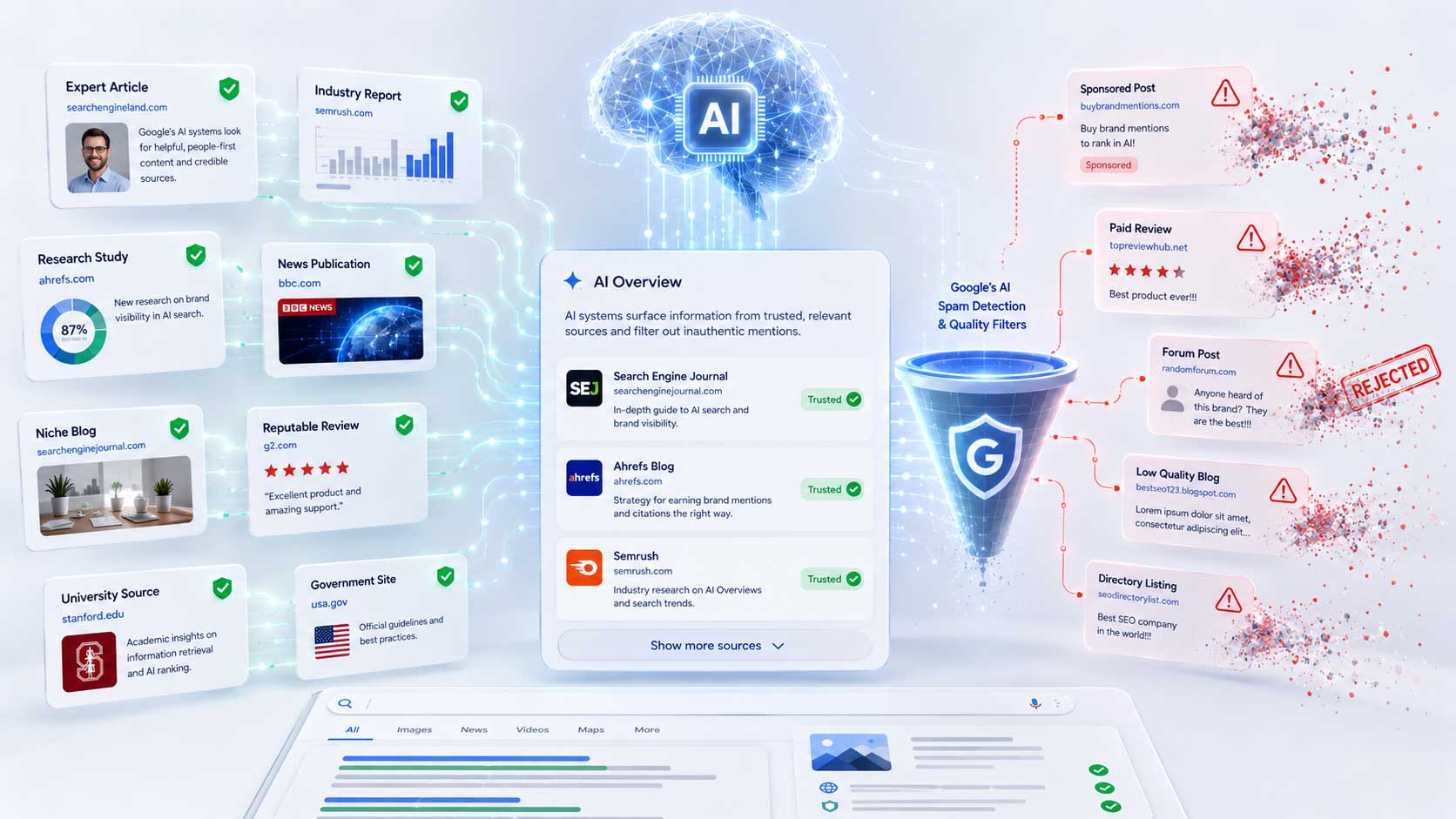
They strongly cautioned web marketers against buying or manipulating mentions across the web, and compared the practice to paid links. Google currently uses advanced internal systems to detect and, when possible, ignore paid links.
While it isn’t clear which systems detect paid AI mentions now, Google has considered this problem before. Inauthentic mentions are covered in the company’s guide to optimizing your site for generative AI features.
Google may have trouble detecting these features now, but you’re warned that there was also a pre-Penguin era for paid links. Things can turn around overnight with new updates.
In the final story of the month, Google may face serious fines over its business practices in the EU. It may mean changes to Google’s policies worldwide.
EU Plans to Fine Google a High Triple-Digit Million Euro Sum, Handelsblatt Reports
Reuters brings you this look at the results of an EU investigation into whether Google overly favored its own services in its search results. The investigation dates back to March 2025, but may now be reaching its conclusion.

Google has made several changes in response to accusations of violating Europe’s signature tech law, the Digital Markets Act (DMA), including what it called “the biggest downgrade in the product’s history” for EU users. However, the changes so far have not satisfied regulators.
If an agreement can’t be reached, the fines are now estimated at 9 figures. The EU trade commission is insisting that it prefers compliance over fines, but is not satisfied with what Google has offered so far.
There’s no telling what might change as a result of this case, but if it affects online marketing, you can read about it in an upcoming roundup.


