It’s another roundup you can miss as AI marches forward and Google begins to remake its entire search product. We’ve gathered the headlines from the last month that you’ll need to stay up-to-date and ahead of the competition.
First, you’ll learn about Google’s big new ad update, take a deep dive into how Discover could be your source for millions of clicks, and get some fresh insider insights from Google’s head of Search on building in a World of AI.
Next, you’ll explore the neuroscience of addictive storytelling, examine whether Reddit is the key to building AI search visibility, and get inside one marketer’s experience with building better meta ads through many mistakes.
Finally, you’ll learn why ChatGPT chooses one page over another (based on more than 1 million interactions), and why Google is accused of breaking SEO with recent updates. Speaking of Google, they’ve also dropped a new policy covering back-button hijacking. Let’s jump in!
HUGE New Google Ads Update!
https://www.youtube.com/watch?v=QtNulfExUSo
Ben Heath breaks down one of Google Ads’ latest updates and the new toys it delivers. The standout feature of the bunch is Google’s new video-capable gen-AI model, now built into Ads.
You’ll get to see a preview of what kinds of assets you can build. The model can generate realistic-looking “live video” with natural motion, realistic backgrounds, and clear voiceovers entirely with AI.
Ben takes you through the options that are now available to you in the VEO toolset. You’ll get a look at how to begin different types of content, including lifestyle images that feature any products you’ll upload.
The toolset also includes the option to animate any images, to create images from still photos, and to create complete original creative assets according to the options you select.
Near the end of the video, Ben offers some analysis for advertisers based on his experience. He argues that these videos may not be ready to compete with videographers and editors for high-end products, but they are good enough for many situations and great for pitches and tests.
Check out the entire video to learn more about these new ad tools. Next, an SEO explores some Google Discover secrets and the features of content that can deliver millions of views.
Google Discover Secrets: How One Article Can Drive 5M+ Daily Clicks
https://www.youtube.com/watch?v=V3Z8jArf2es
Edward Sturm takes you through a recent popular viral post about Discover and offers his own commentary on the often misunderstood power of this channel.
He starts by exploring the claim that Google is the most powerful free traffic source for publishers. It does have a lot going for it. It is present by default on every Android device. It also doesn’t require a download, an account, or a separate app. It’s just available to anyone who visits Google.
Edward spends much of the video discussing the differences between SEO and Discover content. He explains why it matters that you “stop the scroll” when building Discover content, and why you have to prioritize what your audience wants.
He also dives deeper into what successful content looks like on Discover. In this channel, titles and images have extraordinary power to attract millions of eyes, and optimizing them can backfire. Testing revealed that more emotional titles performed better, and emotional images performed up to 50% better than standard stock images.
Check out the full video for more analysis of the post and Discover, a powerful channel. Next, you’ll get some insider knowledge from the Google team on where the future of AI is going.
Google’s Liz Reid on Who Will Own Search in a World of AI | Odd Lots
https://www.youtube.com/watch?v=DP8qe2Qo2-s
Bloomberg Podcasts brings you this interview with Liz Reid, who currently oversees Search at Google after more than 20 years with the company. She and the host discuss what’s changing with the rise of large language models like ChatGPT and Claude.
They discuss how AI is bypassing old search bars and creating tension for large tech companies that offer both AI models and search-related advertising.
You’ll learn a lot of interesting insider details about the dilemmas that Google’s team struggled with, and the reasoning behind some of the decisions they’ve made about integrating AI. They talk about privacy, accuracy, and problems arising from early tests.
There are also some predictions for the future and speculation on how these features are likely to impact businesses over time. Liz also discusses the future monetization of AI features and how Google may approach it.
Check out the rest of the video for almost an hour of insights from one of Google’s longest-serving team members. Next, you’ll learn how you can make your marketing storytelling more addictive by understanding the science.
The Neuroscience of Addictive Storytelling (And How to Master It) Kallaway
https://www.youtube.com/watch?v=KyC8r-zitVE
Kallaway brings you this look at how addictive storytelling acts on the mind. He argues it works exactly like any other stimulation, and when you understand how the body really responds to it, you can tell more effective stories.
First, he lays out his idea of how the brain’s pleasure center works and responds to stimuli. He argues that most people misunderstand dopamine as a pleasure chemical when it is a prediction chemical. It fires when you anticipate a reward, but recedes when you receive it.
So, he argues, you create a reliable source of dopamine for your audience when they’re anticipating what’s next, but bore them and send them to the next attraction as soon as you give them what they want.
He reveals a 4-step loop that he claims will keep your audience hooked on your story. His steps are:
 Stakes: A reason to care
- Big Story: A reason to pay attention
- The Head Fake: A subversion of expectation (possibly the largest source of dopamine)
- Re-Hook: New possibilities to predict are presented
Kallaway supports these theories with compelling comparisons to how casinos already operate. This story format appears in any game of blackjack, and Kallaway argues, in most of your favorite stories.
Check out the full video to learn more about this loop and how to apply it to your own marketing storytelling. Next, Reddit has been presented as a key to AI search, but what does testing say?
Is Reddit REALLY The KEY to AI Search? Let’s Find Out…
https://www.youtube.com/watch?v=f03ZfdtkMzk
I bring you this look at Reddit’s power to help you improve your AI visibility. Recently, I helped a client multiply their AI mentions by 20x using only Reddit. I think many other brands are well-positioned to achieve the same results, or better, and throughout the video, I explain how.
For serious growth, you’ll need to focus on the right Reddit threads. You’ll also need to know how to show up at just the right time when your customers are interested in a recommendation, and how to use Reddit conversations to drive real traffic.
It’s important to do this right because even slightly spammy behavior can get you banned from Reddit before you can generate any good conversations. That’s why the first step to succeeding on Reddit is to not look like a marketer at all.
You’ll need to reinforce your authenticity, starting with account creation. You need a profile that doesn’t look like marketing. I recommend you keep your profile boring. Use a simple bio and image, and take it easy on the links.
Also, take some time to lurk before participating in any community. You want to watch for what behavior is rewarded (upvoted) and what results in verbal attacks or instabans. Start with smaller, niche subreddits and work your way up when your account has more history.
Throughout the rest of the video, I’ll show you how I operate on Reddit. I’ll show you how to create comments that are helpful, how to adopt different “posting styles”, and more. I show you examples of the exact types of comments that have appeared in search.
Check out the complete video for more about turning Reddit comments into AI visibility. Next, learn how to do meta ads right by learning from someone else’s mistakes.
I paid $2000 figuring out meta ads (so you don’t have to)
https://www.youtube.com/watch?v=0YHKGcHetOA
Adam Lyttle shares all the mistakes he made while building meta ads. At the beginning, he was spending a blistering $36.87 for each user who took the right action. By the end, he had that down to only $6.87.
He shares his most expensive mistakes, the strategies that reduced costs the most, and the unspoken lessons he had to learn.
His mistakes were very costly in some cases. He discusses his mistaken impression that App Store Ads and Meta Ads would work similarly, and how the poor reception of the first set of ads led to the loss of hundreds of test dollars.
He explains how he refined his goals to focus on reducing the cost per install, increasing trial signups, and eventually closing free trials to build more credibility with his target audience.
Check out the complete video to learn more about how you can build better Meta ads. Next, you’ll get to see some new numbers. Ahrefs looked into exactly why ChatGPT seems to prefer one page over another.
Why ChatGPT Cites One Page Over Another (Study of 1.4M Prompts)
https://ahrefs.com/blog/why-chatgpt-cites-pages/
Louise Linehan and Xibeijia Guan bring you this fresh research covering ChatGPT’s choices. They looked at more than a million prompts to see which patterns would emerge. The team found some very interesting ones.
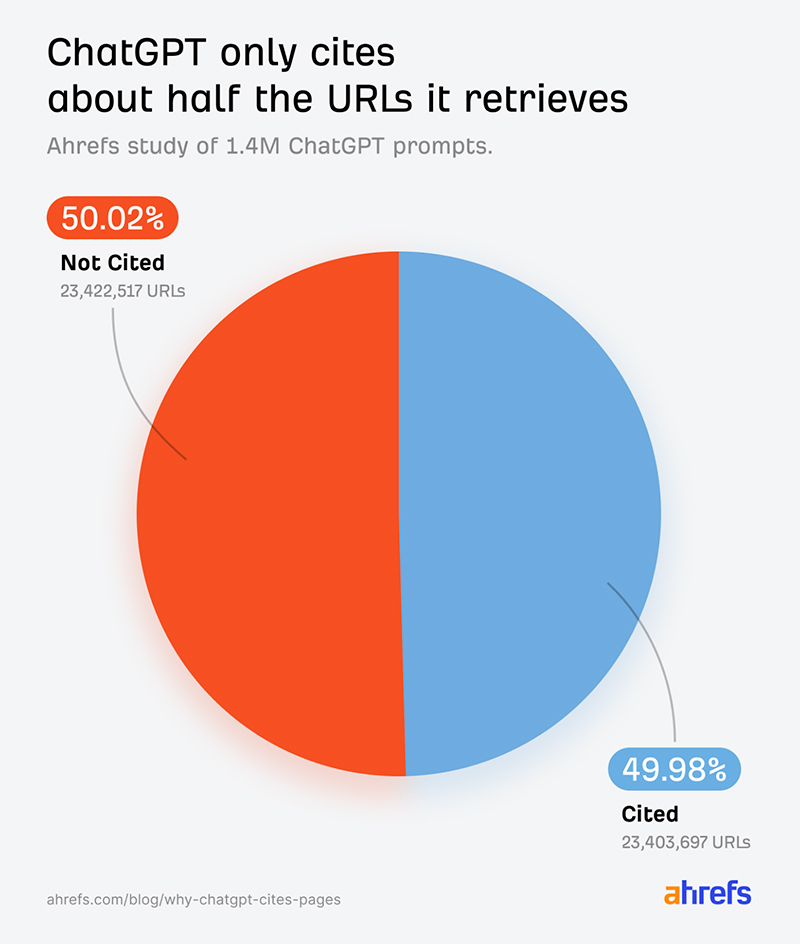
First, they identify a “gatekeeping layer” in ChatGPT that operates before it opens and reads any of your site content. ChatGPT places special emphasis on titles, URLs, and snippets to decide if the content is worth exploring further.
After ChatGPT retrieves results, it categorizes sources using an internal field called ref_type. This is a label for the retrieval channel through which the URL came. Testing revealed five categories that the LLM used:
- Search
- News
- Reddit
- Youtube
- Academia
The team found significant differences in citation rates across categories. Search-categorized information resulted in citations almost 90% of the time, while academia-categorized information surfaced citations less than 1% of the time.
The team found that, ultimately, the pages cited are those with titles and content that match the questions ChatGPT is asking behind the scenes and that come through the right channels.
Check out the complete study to learn more about what to expect from ChatGPT and how it may react to your future content. Next, you’ll find out why one SEO is accusing Google’s CEO of breaking SEO.
Google’s CEO Just Broke SEO
https://www.youtube.com/watch?v=IxC9zwX-BiE
Caleb Ulku brings you this breakdown of Sundar Pichai’s full interview with John and Elad Gil of Stripe. In this interview, the guest and hosts discuss Google’s vision for search in the age of AI, including some information on agents and how they are likely to affect local search.
Reacting to this interview, Caleb breaks down the key moments where Pichai discusses the evolution of search, the role of agents, and why the fundamentals of local search are more important than ever.
Caleb argues that there is a lot of concerning news for local search professionals here. One phrase that really concerns him is “agent manager”, one of the roles that Pichai identifies for Google in the future.
However, Caleb doesn’t think local search matters anymore. He argues that GMB is already the exact kind of asset that AI is looking for to source structured answers. As he says, AI is not becoming the new index of information; it’s becoming the new user seeking information.
Check out the full video for more on AI Overviews, agents replacing traditional search, and what Google’s strategy means for local visibility in 2026 and beyond. In the last story of the roundup, you’ll find out if you’re safe from Google’s newest spam policy.
Introducing a new spam policy for “back button hijacking.”
https://developers.google.com/search/blog/2026/04/back-button-hijacking
Google brings you this notice for anyone engaging in the process of “back-button hijacking.”
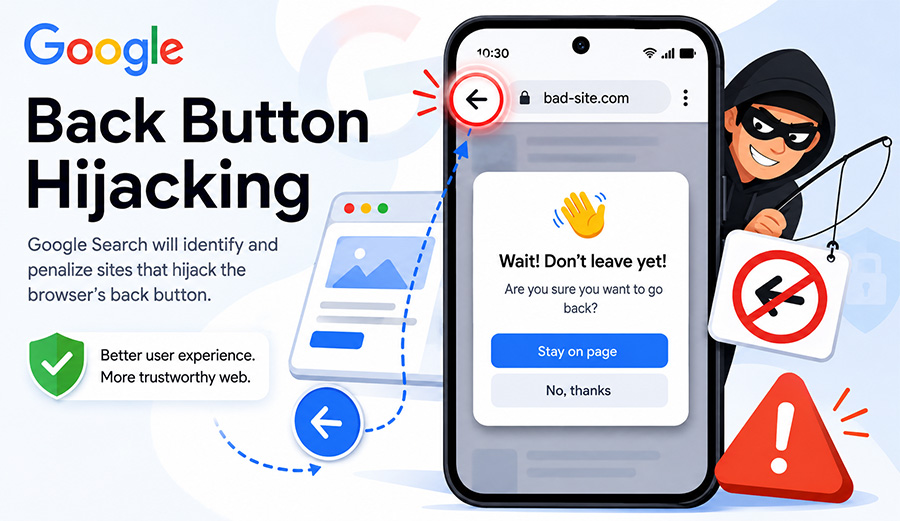
This type of spam occurs whenever a site interferes with a user’s browser navigation and prevents them from using their back button to return to a previous page immediately. Violating behavior includes:
- Sending users to pages they have never visited before
- Presenting them with unsolicited recommendations or ads
- In any other way interfering with navigation
This is now an explicit violation of Google’s Spam policies, which means it can now result in site-wide actions. Google argues this is necessary because of a recent rise in this type of abuse.
Google reminds all site owners to ensure they are not interfering with navigation in any way as this policy goes into effect. They note that some technical errors and even ad platforms may cause violations.
That’s all the news for this month. Make sure you check back next time for more of the internet’s top marketing news.


