November was a big month in digital marketing, and you shouldn’t miss this roundup if you want to be prepared for all the changes likely to arrive early next year.
In the top stories, you’ll learn the real impact AI Mode has had on SEO with 10 case studies, find out how Google’s new exec is planning to “reinvent” search, and hear the latest chatter on an unconfirmed algorithm update.
Next, top minds in online advertising discuss whether social media is over, what happens when AI is let loose to run an SEO campaign, and what changed with Google’s big Gemini update.
In the final pieces for the month, you’ll get new techniques for managing AI agents, find out the most effective times to post video marketing updates, and hear Google’s latest reaction to the lawsuit against their ad business. Let’s jump in!
The Impact Of AI Mode On SEO – Analysis Of 10 Studies
https://www.searchenginejournal.com/the-impact-of-ai-mode-on-seo-analysis-of-10-studies/558816/
Kevin Indig presents these recent AI mode studies, providing insight into what the earliest data can already reveal. He dug up everything the data could reveal, including how AI mode impacts clickthrough rates, how quickly it’s being adopted, and whether it’s giving accurate answers.
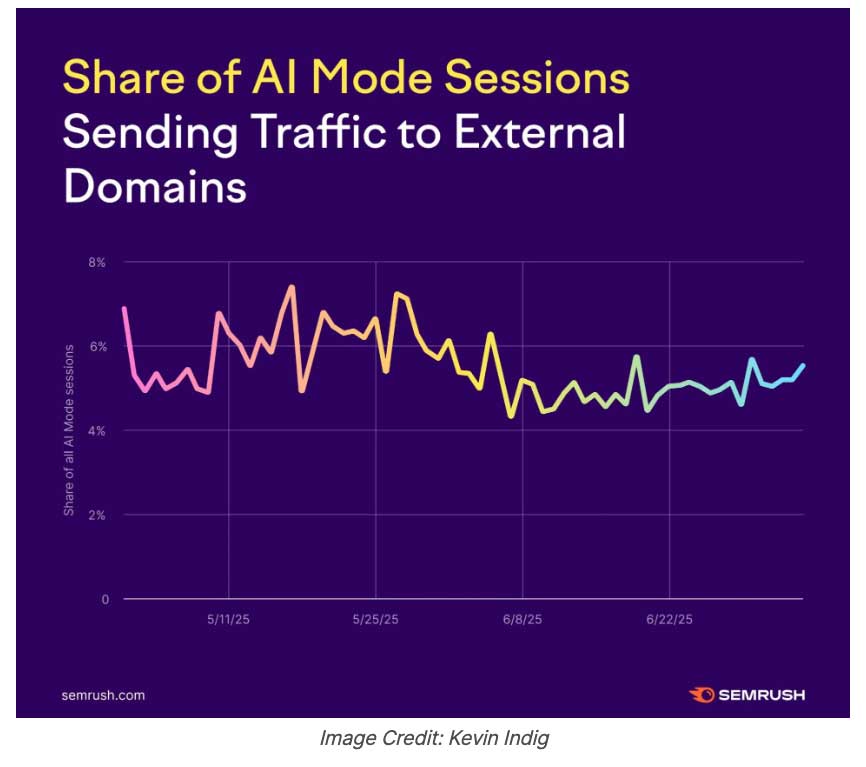
He focused on case studies that could provide the answers advertisers need, including the real relationship between AIO and AI Mode, and how brands can still benefit from AI Mode visibility. The analysis revealed a number of interesting facts for marketers, including:
 92 – 94% of AI Mode sessions result in no external click, and only 6-8% produce any outbound traffic
- 77.6% of…directed search task sessions had zero external visits, and the median external clicks per task were zero
- …Only 2-5% of participants used AI Mode across five tasks, while 30-47% engaged with AI Overviews
- AI Mode produces longer answers (~300 words), similar to ChatGPT, and uses more unique domains (~7 per answer) than AI Overviews (~3)
- Participants spent 52-77 seconds reading AI answers per task and often concluded their research within the pane
Check out the complete write-up to learn more about the ten studies that were analyzed, and see some discussion on the implications for the future of SEO.
You’ll get even more insight into the future in the next piece profiling Google’s Head of Search, Liz Reid.
The Google Exec Reinventing Search in the AI Era | WSJ’s Bold Names
https://youtu.be/XMON7wg0rds?si=rM_qWrQiKZVWYquc
WSJ’s Christopher Mims and Tim Higgins bring you this interview of Liz Reid (now VP and Head of Search after more than 20 years with Google). You won’t want to miss what she has to say about what she had to say about Google’s AI shift, ad revenue, and more.
Liz starts off identifying AI as one of the largest shifts the company has ever experienced, even larger than the shift to mobile. Across several minutes, Liz covers Google’s history with AI and how it “caught up” after being one of the earliest LLM users.
The ad revenue conversation also covered a lot of territory. Liz lays out how AI may interact with ad experiences in the future. She predicts a bright future. As she and the hosts discuss, Google’s ad revenues are up despite controversies and big changes in technology.
Check out the entire interview, with more questions and commentary about winners and losers in the AI era, Dead Internet Theory, and more, directly from one of Google’s most influential voices.
Of course, Google doesn’t always announce what it’s doing. That’s why the next piece is about the latest unconfirmed update. Were your sites affected?
Unconfirmed Google Algorithm Update? What SEOs Are Seeing Right Now (October 2025)
https://youtu.be/f0-NxVznbl4?si=9HixjC65VGgZC-Xf
Edward Sturm brings you this look at an unconfirmed update. He follows reports from Barry Schwartz and other SEOs who tracked a disturbance across multiple reporting tools. In this video, Edward investigates the aftermath of the incident and what it tells you about the future.
First, as he reminds you, these tools have recently undergone changes that make it far more difficult for them to detect activity. Google began generating only 10 results at a time instead of 100. Tools are starting to work around this policy, but it still affects all the data collected during the update event last month.
Edward focuses on Lily Ray’s post on this issue, where she suggests these moves may predict the priorities of the next big update. She thinks this was a test run for an algorithm update targeting a lot of content issues like robotic pages and listicles.
Watch the complete video for a deeper dive into what was detected and what may be coming. Next, check out some predictions that even greater changes are coming for social media.
Social Media Is Over — This Is the Future of Content | GaryVee w/ Mick Unplugged
https://youtu.be/Ehp0Rjl5wf4?si=JBn2Qv9mhdna1TQ1
GaryVee brings you this look at the future of content if social media is truly “dead.”
As a guest on the Mick Unplugged podcast, he addressed a lot of concerns that newer content creators have with the environment in which they’re trying to create brands. He explores the fears and questions they have about creating content when nothing feels original anymore.
Throughout a lengthy discussion, Gary identifies the sources that can still create thriving brands. He discusses what it means to generate random, honest content and what it means when he says that followers no longer matter.
He has a lot to say about creating content in particular. In the video, you can see him explain how to build content from the perspective of intent and how to make something original instead of copying the culture around you.
Watch the complete video for more urgent advice on how to keep your social media strategy current. Next, what happens when you let an AI run your SEO campaign?
I Let an AI Run my SEO Campaign. Here’s what happened…
https://youtu.be/xG9Vu9yrQzw?si=zb4au9gOzZEmIypw
Can an AI run an SEO campaign? I gave one a chance and, in doing so, increased a client’s revenue by almost 200% (netting him in excess of $300,000). The AI I built runs the entire campaign, and in this video, I tell you how to make one yourself.
First, I go into how I built a bot that handles all the other bots you’ll need to create a comprehensive campaign. I used a simple no-code automation tool that could connect to GPT and generate the functions I need. You’ll learn how to make one, too.
Bots still need a guiding strategy, and mine was to build more (quality) content than anyone else in my client’s niche. The top bot was given my target topics and put in charge of hundreds of other bots, which began to generate all the content for me.
To make this bot army and commander deliver good content the first time takes integrating several accounts and tools together, but I go through everything in the video. You’ll learn what tools I used, and what prompts produce the best scaled content.
Watch the complete video to learn more about how it all resulted in massive new revenues in my client’s space. In other AI news, GEMINI got a big update, and there are some details you shouldn’t miss.
New Google GEMINI Update is INSANE!
https://www.youtube.com/live/SA5NqwUSP60?si=4AsvgudXTXMqchL-
Julian Goldie brings you this look at GEMINI’s latest update and what’s coming for creators of video content. In this half-hour video, he breaks down some of the most significant changes, including the improved video detail, the arrival of Gemini 2.5 Flash, and more.
He and other video creators found the increased detail in 3.1 to be stunning. Julian creates several prompts live during the video and uses them to demonstrate the difference between what’s possible with the older model compared to the new one. The differences in lighting are particularly impressive.
Throughout the video, Julian tests most of the other new features live as well, giving you a look at what they can do in real tests and showing you where to find them in GEMINI’s expanded UI.
Near the end of the video, you can see him compare the latest GEMINI outputs with some of the other top video marketing AI tools.
Video generation technology is only getting more impressive, and it isn’t the only AI implementation that’s improving. Next, Cyrus Shephard talks about the early success of agents and other ways AI is changing SEO.
Agents are early, visibility is urgent: Cyrus Shepard on 2025 AI SEO
https://youtu.be/ce_4AR5cx8A?si=2SkqR1ezQfmPjU5_
Cyrus Shephard joins Vaenisaa of the AI SEO show to discuss how AI has really changed SEO based on his decades of experience. He speaks at length about the AI trends he feels are most important, and what strategy changes are necessary to thrive in the new environment.
One of the notable trends he observes is that commerce clients are generally adapting well to AI features, whereas information-based clients are losing out to AI alternatives. Those clients are constantly losing out to AI overviews and rivals that can build out comparable content in days.
Cyrus calls on his own personal experience watching many SEO-based businesses fail or close in recent years. He names travel sites, coupon sites, and other related affiliate operations as examples of businesses he has seen close in recent years.
Despite all the big changes, Cyrus claims he’s still mostly using the same tools that he has used for the last 5-10 years. He argues the biggest difference is that curation plays a larger role than production in his content process.
Check out the complete video to get more analysis from one of the most respected minds in SEO. Next, we revisit video marketing to explore what data reveals about the optimal time to post content.
The Best Time to Post on TikTok in 2025 — New Data from 1m Videos
https://buffer.com/resources/best-time-to-post-on-tiktok/
Kirsti Lang presents this analysis of over 1 million data points to determine the most valuable time for you to post. As the research shows, there isn’t one simple answer, but there are some insights here you could turn into improvements tomorrow.

First, they found that (though there were exceptions based on geography) there were certain times that corresponded to more total shares. Adjusting for your own time zone, the ideal posting hours are:
- Sunday at 8 p.m.
- Tuesday at 4 p.m.
- Wednesday at 5 p.m.
The team tracked all posts from midnight to 10 PM and found that the late afternoon to late evening hours were the best times to post overall.
The team had enough data to narrow down the top three times to post for any given day of the week. Adjusting for your own time zone, you’re better off posting:
 Monday: 7 p.m., 6 p.m., 5 p.m.
- Tuesday: 4 p.m., 8 p.m., 2p.m.
- Wednesday: 5 p.m. 6 p.m., 4 p.m.
- Thursday: 5 p.m., 1 p.m., 3 p.m.
- Friday: 4 p.m. 2 p.m., 6 p.m.
- Saturday: 5 p.m., 4 p.m., 7 p.m.
- Sunday: 8 p.m., 5 p.m., 4 p.m.
Check out the complete write-up to learn more facts, including the best day of the week to post, and how to find out when your audience is most active. Finally, Google has a response to the ongoing court case against its ad business.
Google’s statement on DOJ proposed remedies in ad tech
https://blog.google/outreach-initiatives/public-policy/doj-ad-tech-case-sept-2025/
Google pushed back against a DOJ offer that would have required the company to sell its ad business over monopoly claims. The statement argues that the DOJ’s proposed changes go far beyond the Court’s liability decision and the law.

Google’s VP of Regulatory Affairs, Lee-Anne Mulholland, argued that breaking apart Google’s integrated tools would make it harder for publishers to monetize content and reach new customers, disproportionately hurting the small businesses that choose to use Google.
Shortly after this statement was published, Google lost a different antitrust case brought by publishers. As of November 17th, Google and the DOJ had still not come to a settlement.
That’s all the news on these cases for now, but the final resolutions are likely to change the landscape of online advertising. If there’s more to know, you can read about it in an upcoming roundup!


