
In 2025, the game of SEO has changed.
With advancements in AI, you can build AI SEO experts using code (not humans) to create content at a scale that was previously unachievable…
This case study reveals how my agency, The Search Initiative, leveraged AI to generate $491K in monthly revenue—and why every business should be thinking about AI-driven SEO today.
Our client’s monthly revenue from $166k to $491k.
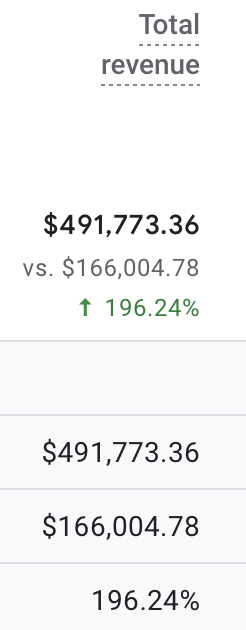
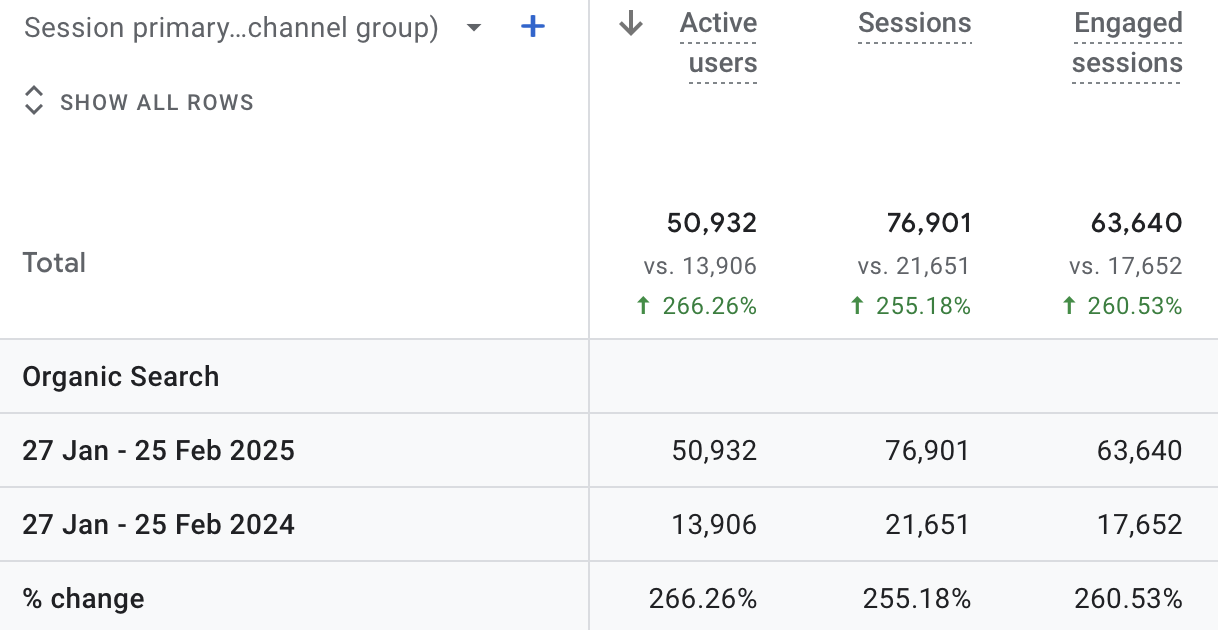
… And increased monthly organic traffic by 255% from 21.6k to 76.9k sessions per month.
In this case study, you’ll learn how to build an AI SEO genius that includes:
 A content system using Google Sheets, ChatGPT and Make.com (a no-code development and automation platform) that allows you to produce more high-quality content for supporting pages, at a lower cost, to boost your SEO results.
- Your very own automated metadata generator that drives organic traffic and conversions by producing SEO-optimized page titles, H1 headings, and meta descriptions at scale.
- An AI-driven link building strategy that quickly strengthens your credibility in Google’s eyes by securing high-quality backlinks from relevant publications
If you’d prefer to watch rather than read, I cover some of the key insights in this video.
To start, here’s some context about the site and why their site needed an SEO boost.
The Challenge
The client is an eCommerce company selling home interiors.
Performance was stagnant before joining The Search Initiative with the client hesitant to invest in SEO again after already investing tens of thousands of dollars with their previous agency who were unable to rank them for important product-related keywords.
Their products weren’t ranking for key search terms, and their content strategy wasn’t built for scale. We needed to expand the site’s visibility by creating new pages that targeted keywords our client was missing out on.

Failure to fix this meant lost revenue and stalled growth. But with a new approach, by scaling their content strategy through automation and executing an AI-powered link-building campaign, we helped them hit $491K per month increasing their revenue by 196% since when they first joined.
Here’s how we did it.
An AI-Powered Approach to Writing Content at Scale with Make.com
Bridging content gaps between your website and the competition is one of the most effective ways to grow your reach and rank for more keywords.
Covering key topics more comprehensively helps build your topical authority. This signals to search engines that your site is a trusted source of information within your niche—leading to higher rankings, more traffic, and increased visibility for your keywords.
By identifying keywords that you’re missing out on and producing content that is optimized for these terms, you’ll increase your chances of bringing your products or services to more eyes.
This can be quite time consuming, so what if you could do it with the help of AI and automation?
That’s exactly what I’ll show you, but it’s worth noting that this should ideally be done for supporting pages (i.e. blog content) and your important pages (i.e. product/service pages, homepage etc) should be handwritten.
This is because while Google doesn’t necessarily mind AI-written content (so long as it’s useful and helpful for your audience), the best content comes from humans. An AI can’t replicate your expertise, it can’t “create” or talk about your experiences.
So, let’s see how you can build this system for your supporting pages.
Finding Content Ideas with Ahrefs & Building Your Spreadsheet
Here’s how you can find supporting topics to cover on your website, by looking at keywords that your competitors are ranking for, but you aren’t.
For this, we’ll use Ahrefs’ Competitive Analysis tool.
Enter your domain, along with links to your competitors.
Let’s say my website sells fresh produce, and I wanted to expand the content by creating supporting recipe pages that showcase my products,
In this case, I’ll find the top ranking recipe sites so that I can find relevant recipe keywords and add them to Ahrefs’ Competitor Analysis tool.
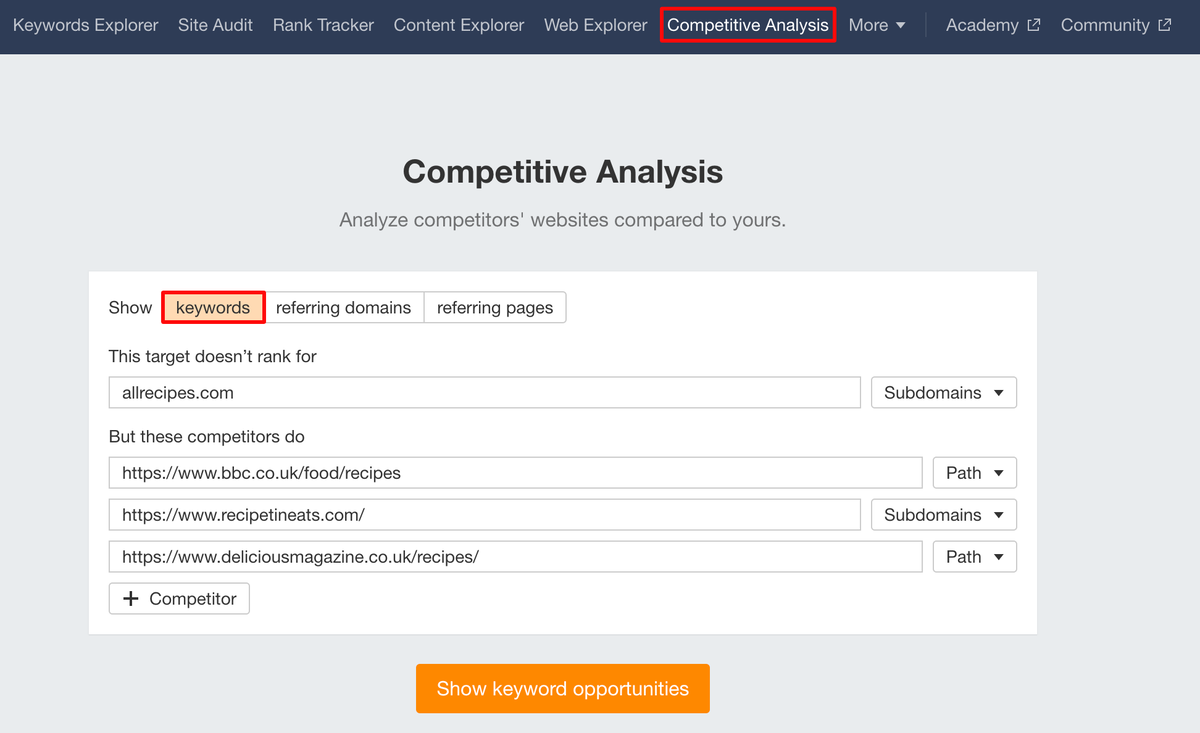
You can add up to 10 competitors.
By default, the tool displays every single keyword that all of the competitors rank for, but you don’t. Note that some of these terms might not be relevant to your site.
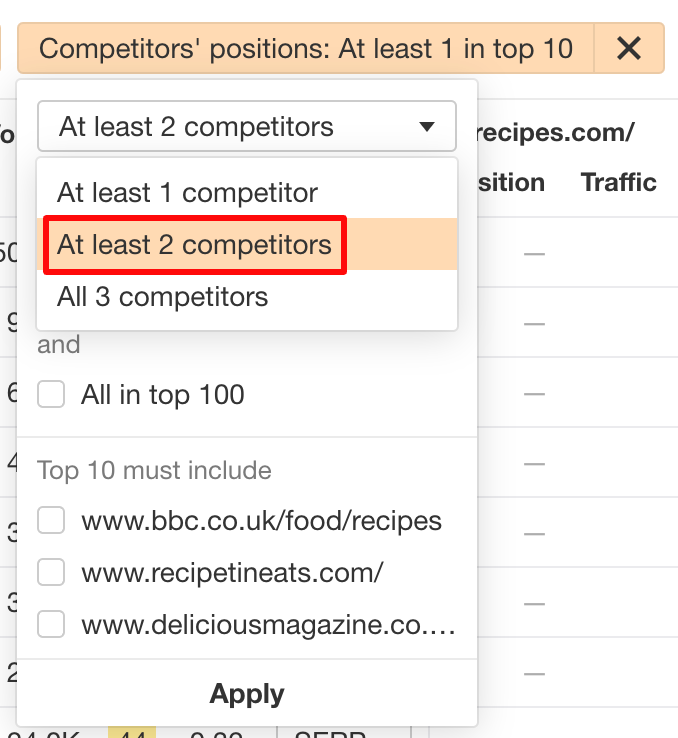
Narrow down the search so that you only see keywords where at least more than one of the competitors is ranking for.
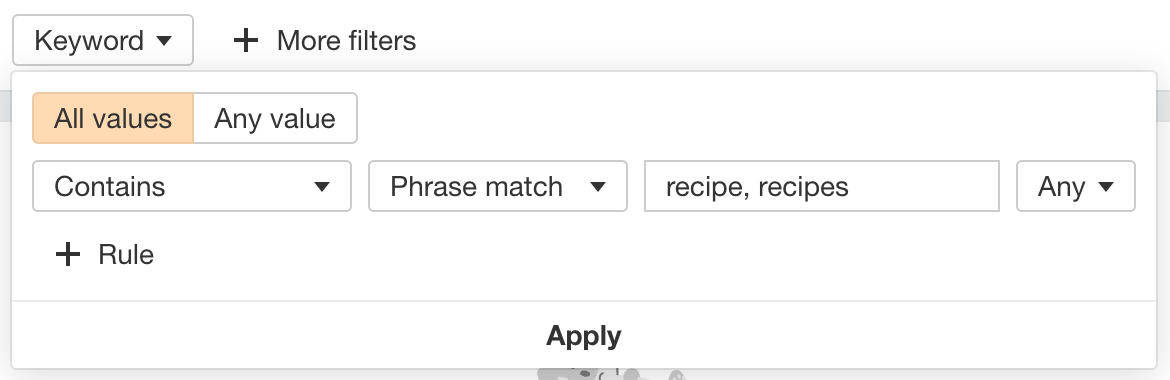
In my case, I only want to see which recipe pages I’m missing out on, so I’ve filtered the results even further so that they only include keywords that contain “recipe” or “recipes”.
Now you’ve got a list of relevant keywords that you’re missing out on.
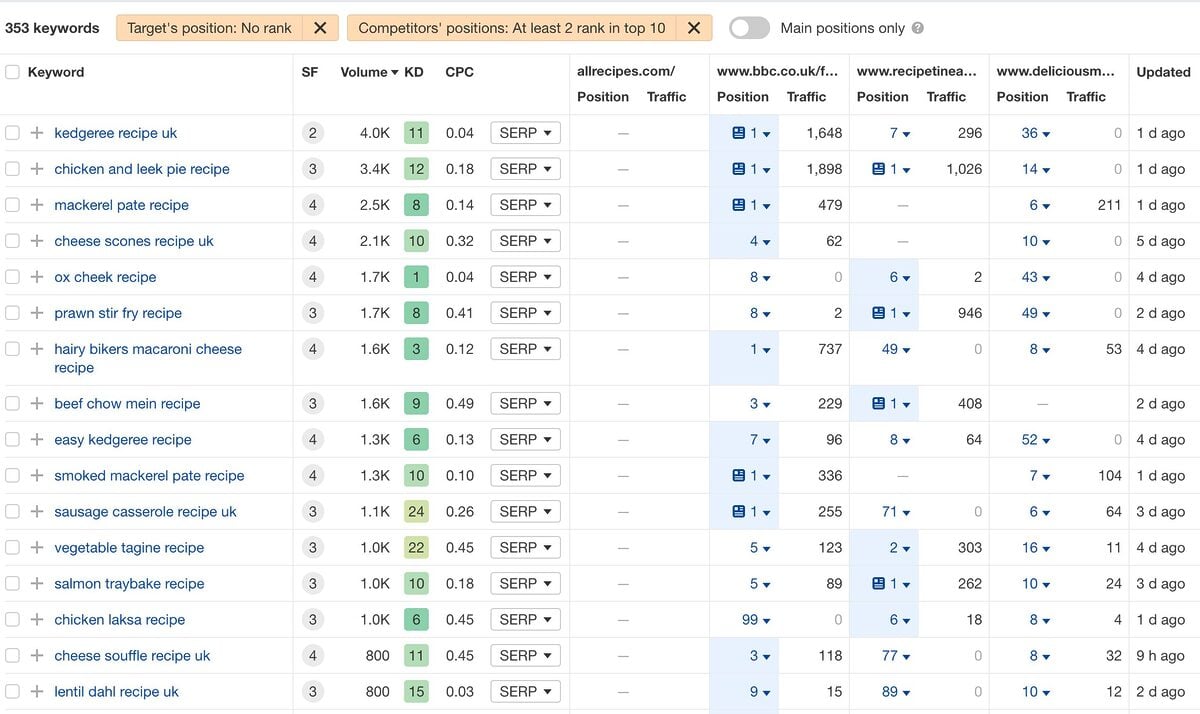
The next step is to identify any topics/keywords that are relevant to your site that you want to publish too.
Create a spreadsheet (Google Sheets), which will house the relevant information used by the AI to create your content.
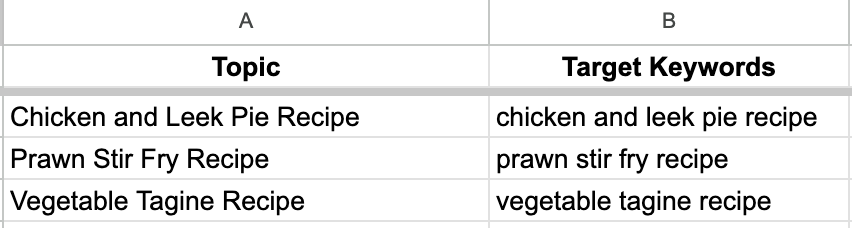
Your sheet should have the following columns:
 Column A: Topic – the topic / title that you want to cover.
- Column B: Target Keywords – the main keyword(s) that you want to rank for.
It should look something like this:
Now that you have a list of topics in your spreadsheet, here’s what you’ll need to start the automation:
- Make.com account (free or Pro) – it’s a platform that lets you connect apps like Google Sheets, Google Docs, ChatGPT (and many more) and automate workflows without needing to write code.By linking these tools to create automated processes that you can reuse again and again, you’ll be able to save significant amounts of time and effort.In this case, we’ll be using it to manage OpenAI’s LLM to create thousands of pages at scale.
- OpenAI account (plus or pro subscription required to use API)
Connecting Google Sheets to Make.com
- Create a new Scenario

- Give it a name i.e. “Content System”.

- Click on the Plus sign to add an app and search Google Sheets.
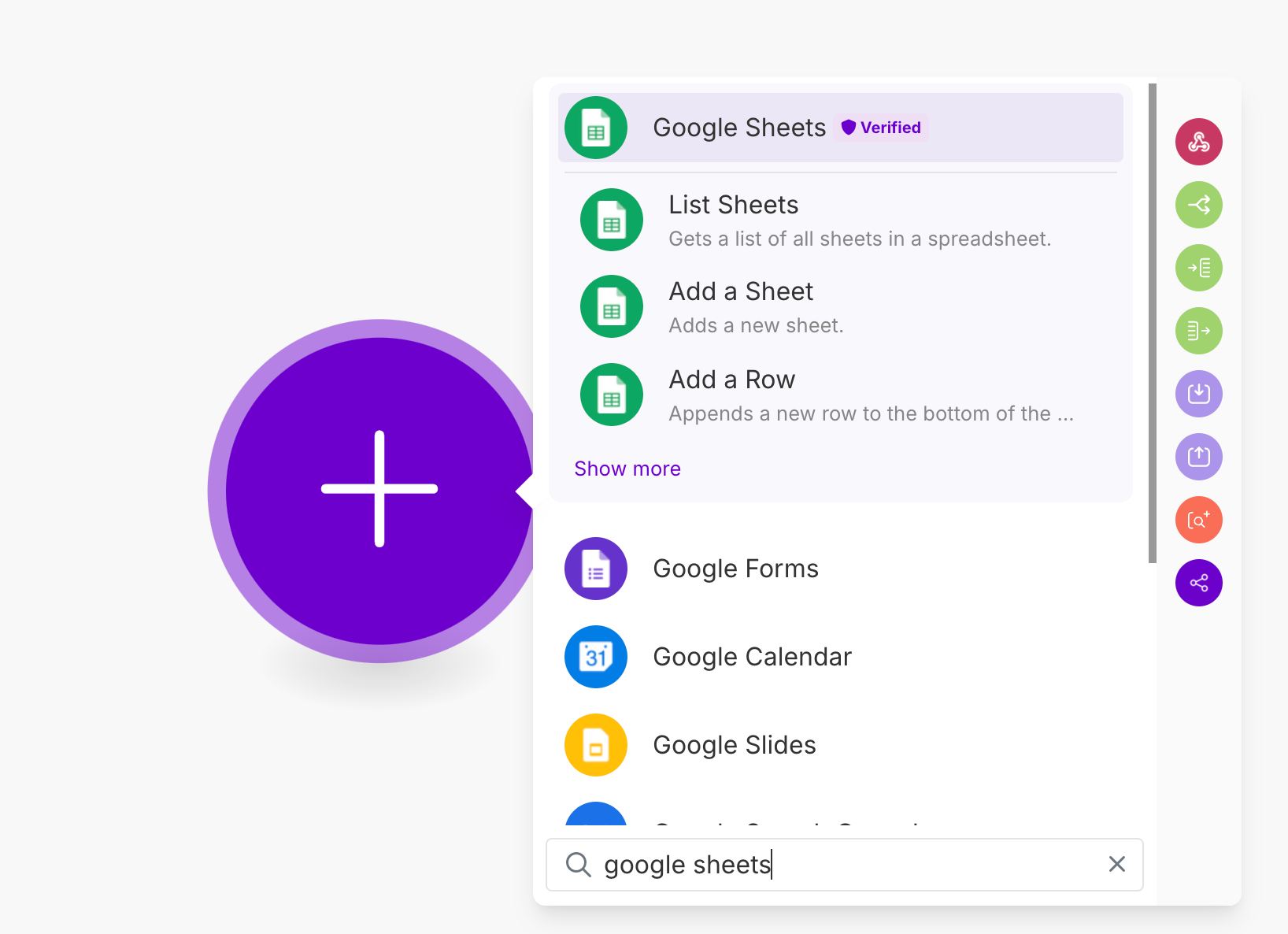
- Select “Get Range Values”. This is how the tool will know what information it should use in order to generate our metadata.
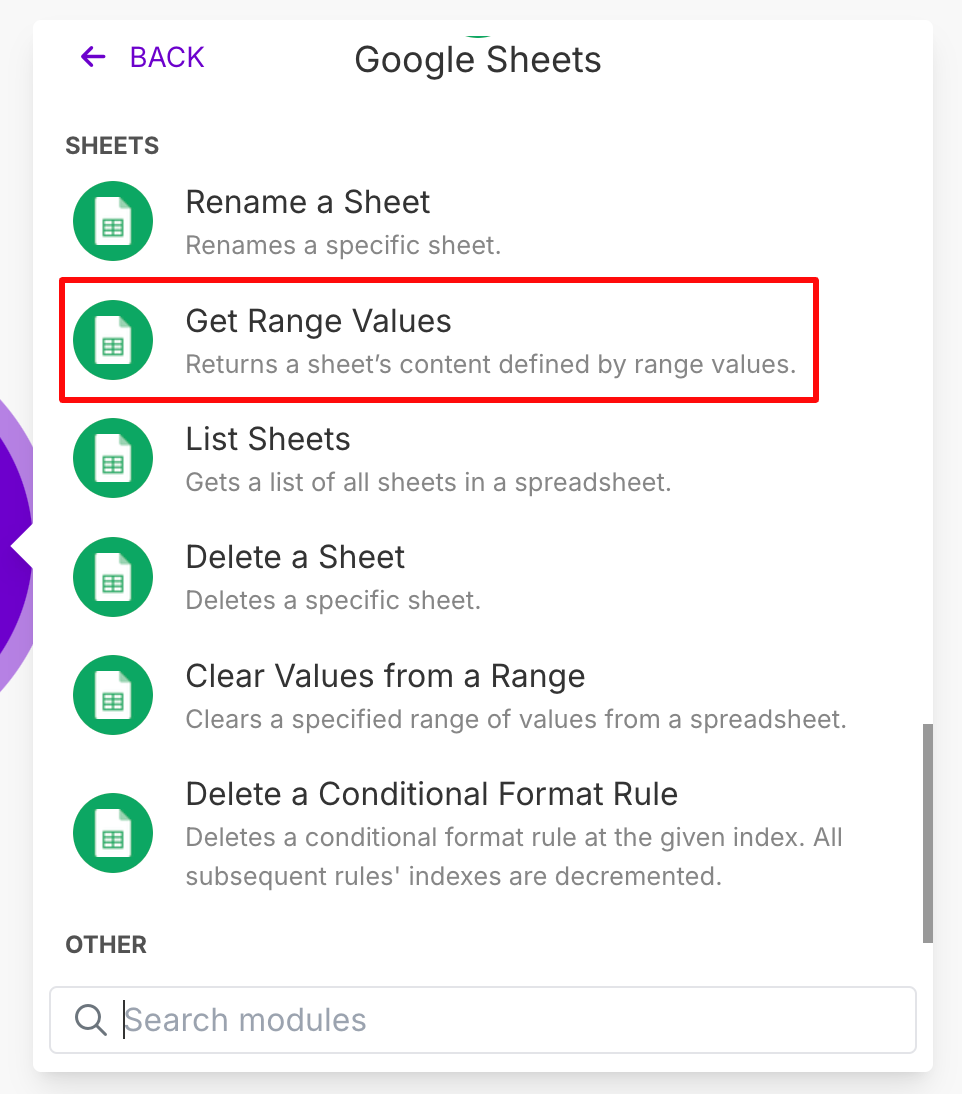
- Connect to your Google account by adding a connection.
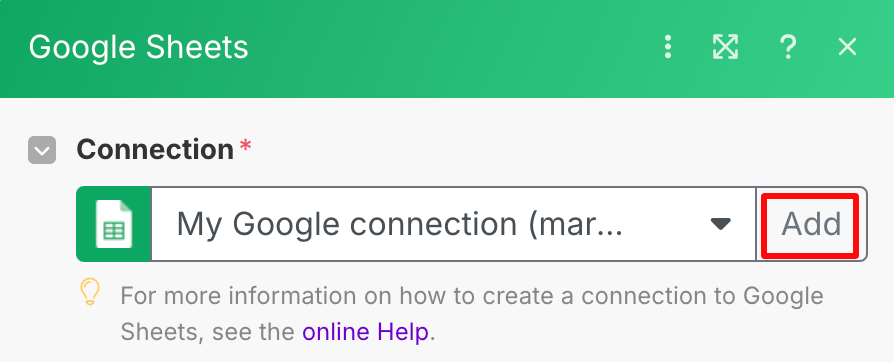
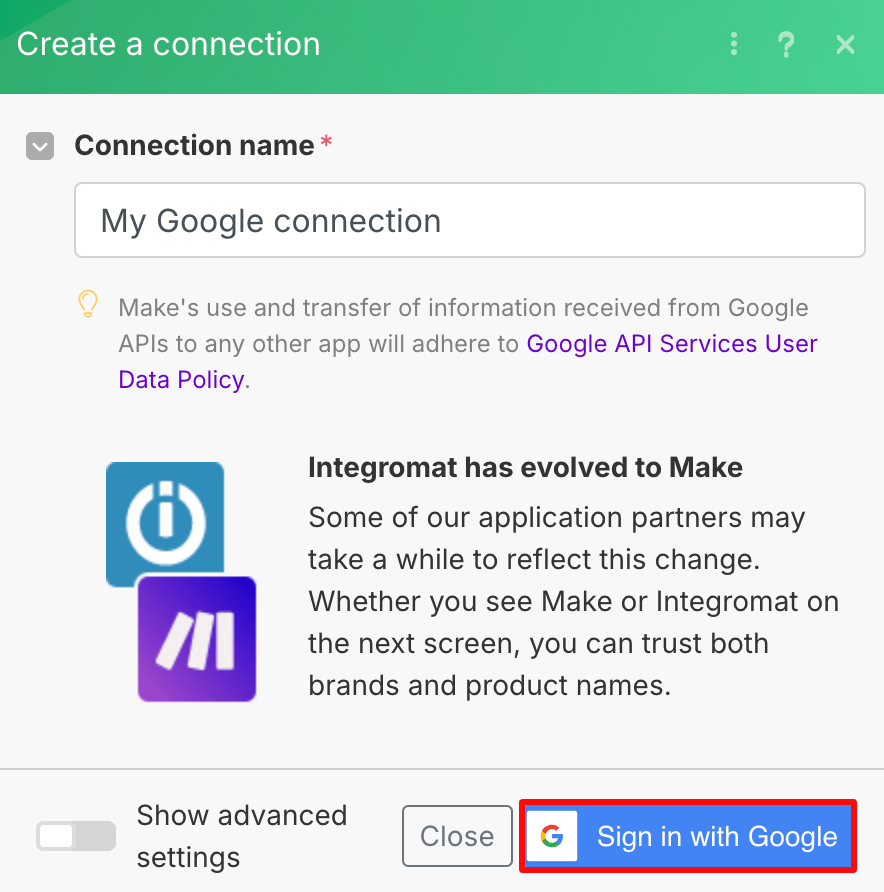
- Give it a name and follow the steps to Sign in with Google.
- Make sure:
 Search Method is set to “Search by Path”
- Drive is set to “My Drive”
- Spreadsheet ID is linked to the file where your sheet is saved in your Google Drive i.e. if it’s saved in the root folder, then the path would be “/ Your Spreedsheet Name”.
- Sheet Name is selected according to which sheet the information is saved on i.e. “Content”.

- For the Range, you want to give it the range of the cells whose data you want the tool to use.
This is the Topic and Target Keyword(s) that you want the AI to use when generating your content.

- For Table contains headers, select “Yes”, then enter the range for where the headers are. In my example, it’s “A1:B1”

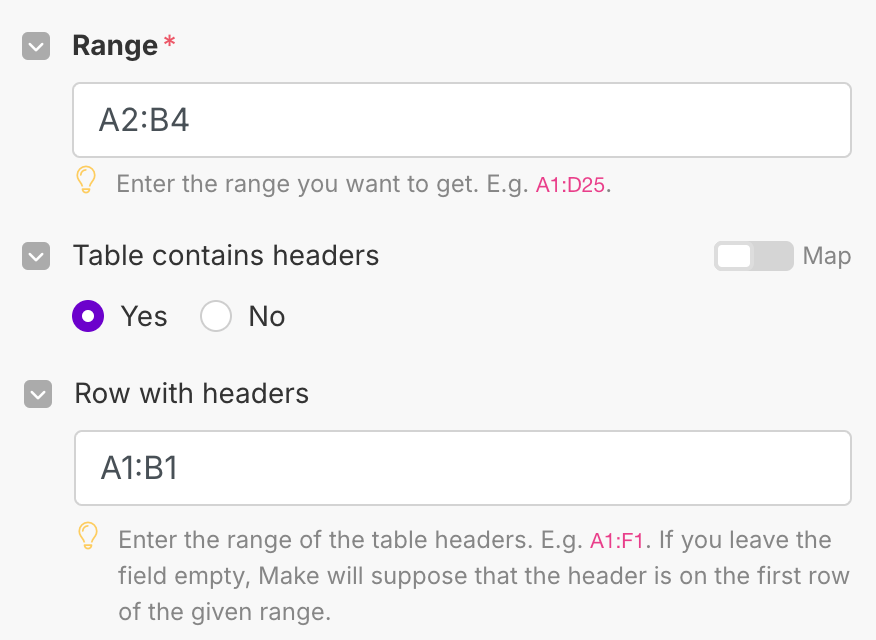
- Click Save.
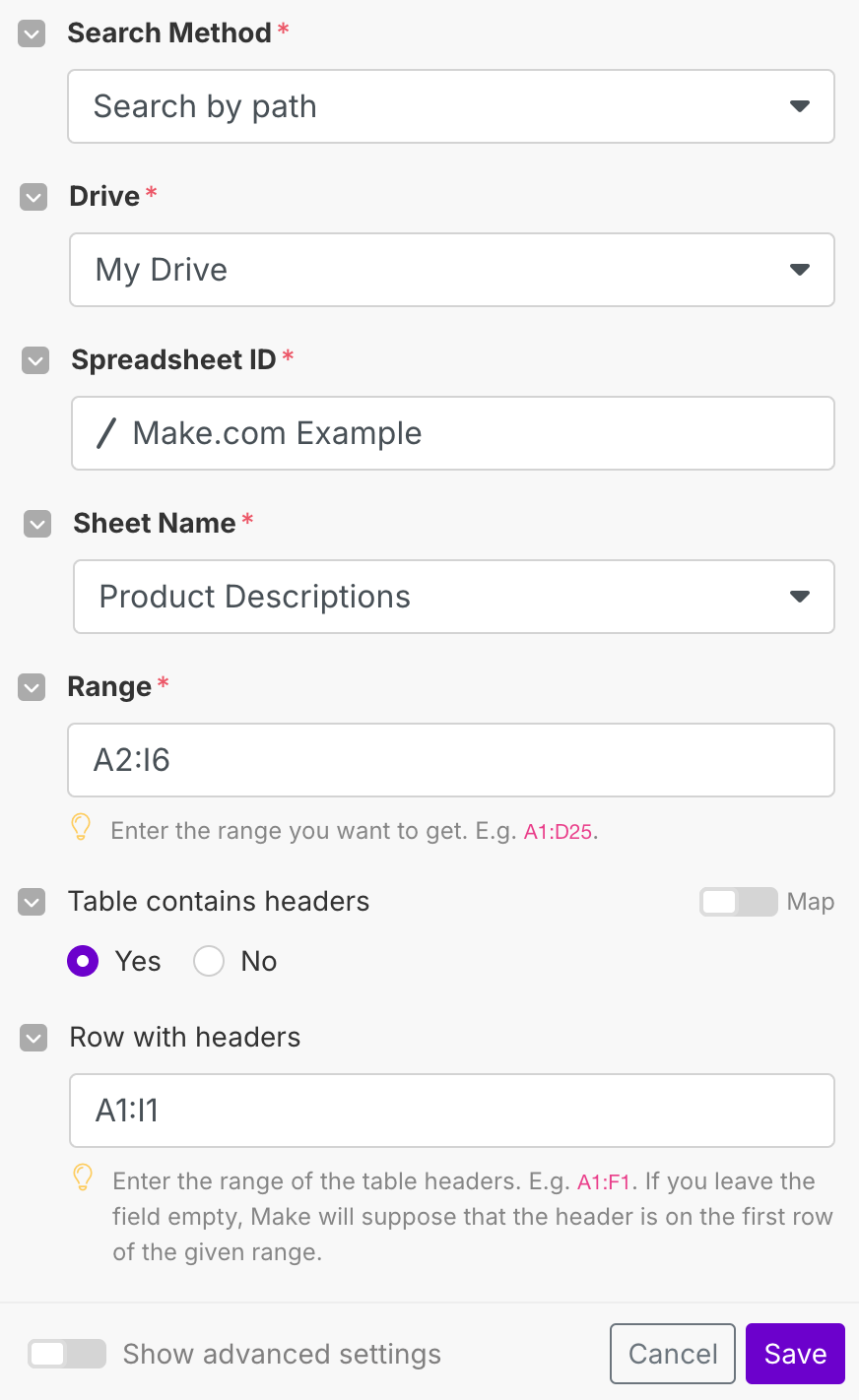
Your spreadsheet is now connected to Make.com.
Creating Your Content System with ChatGPT (OpenAI)
Now that the spreadsheet is connected, the next step is to add a new module for OpenAI so that you can connect it to ChatGPT.
- Click Add another module and search OpenAI.
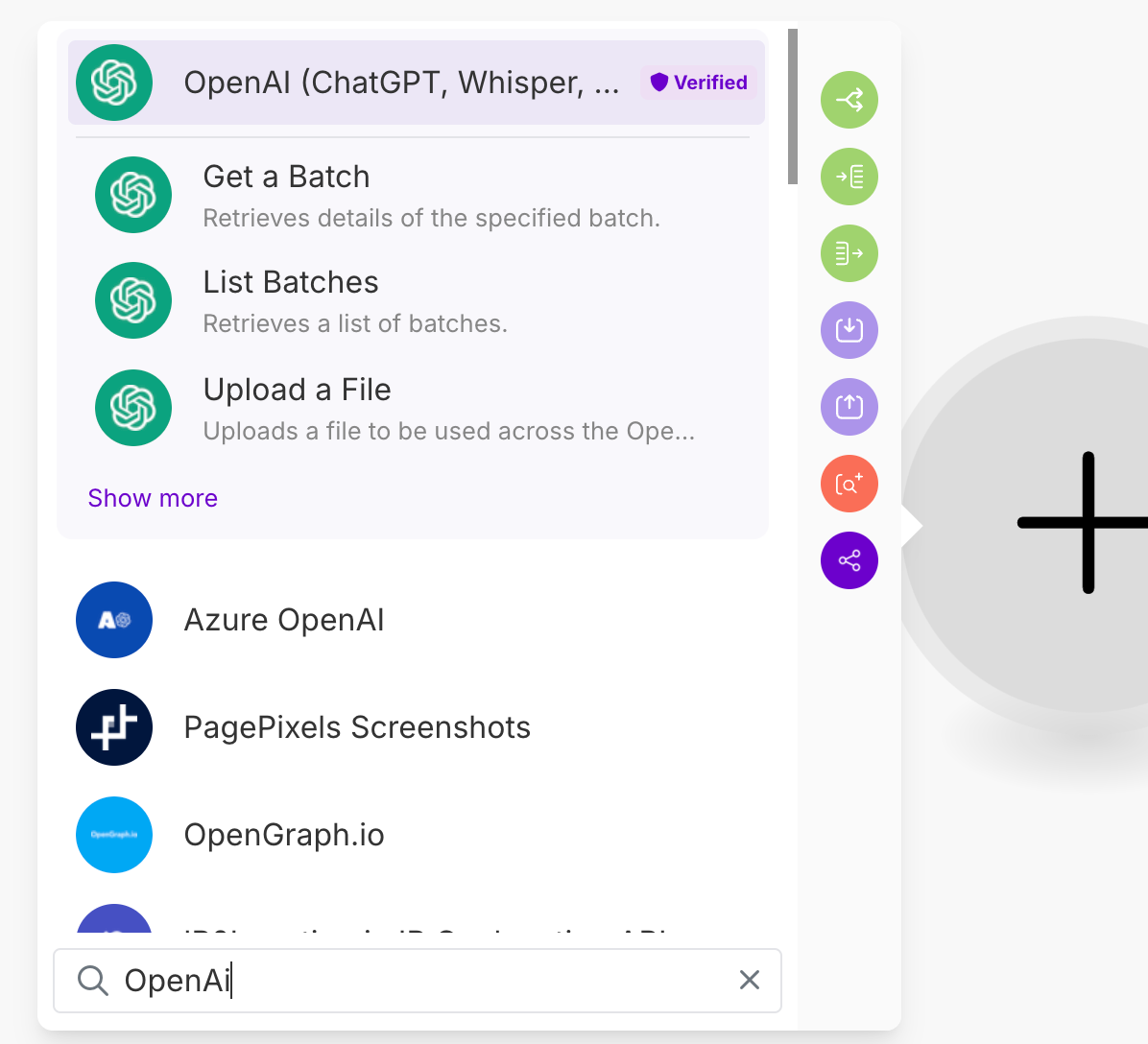
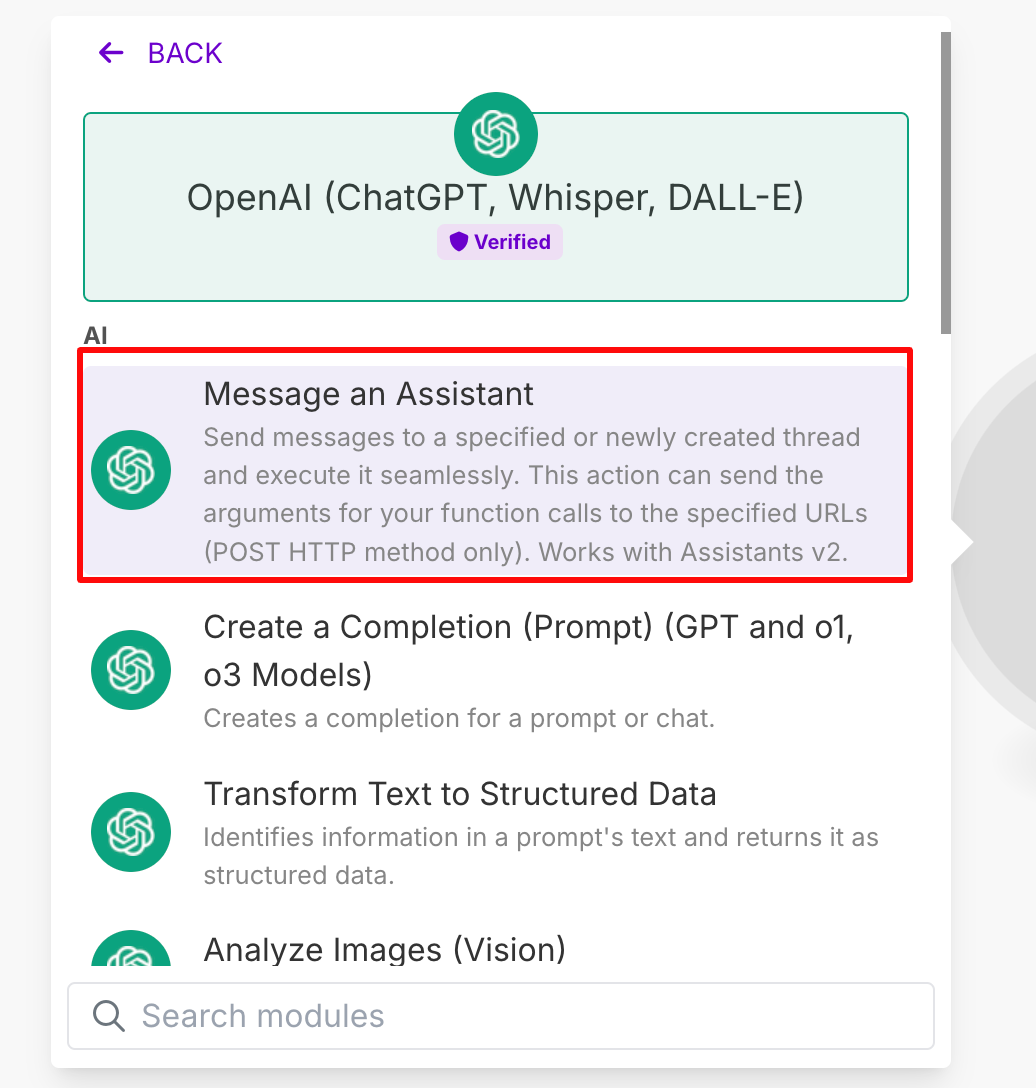
- Select Message an Assistant, this is what will allow you to provide GPT with a prompt.
- Like you did with your Google account, connect your OpenAI account.
To do this, you’ll need to create an API key by signing in and going on this page.
Give it a name and click “Create secret key”.
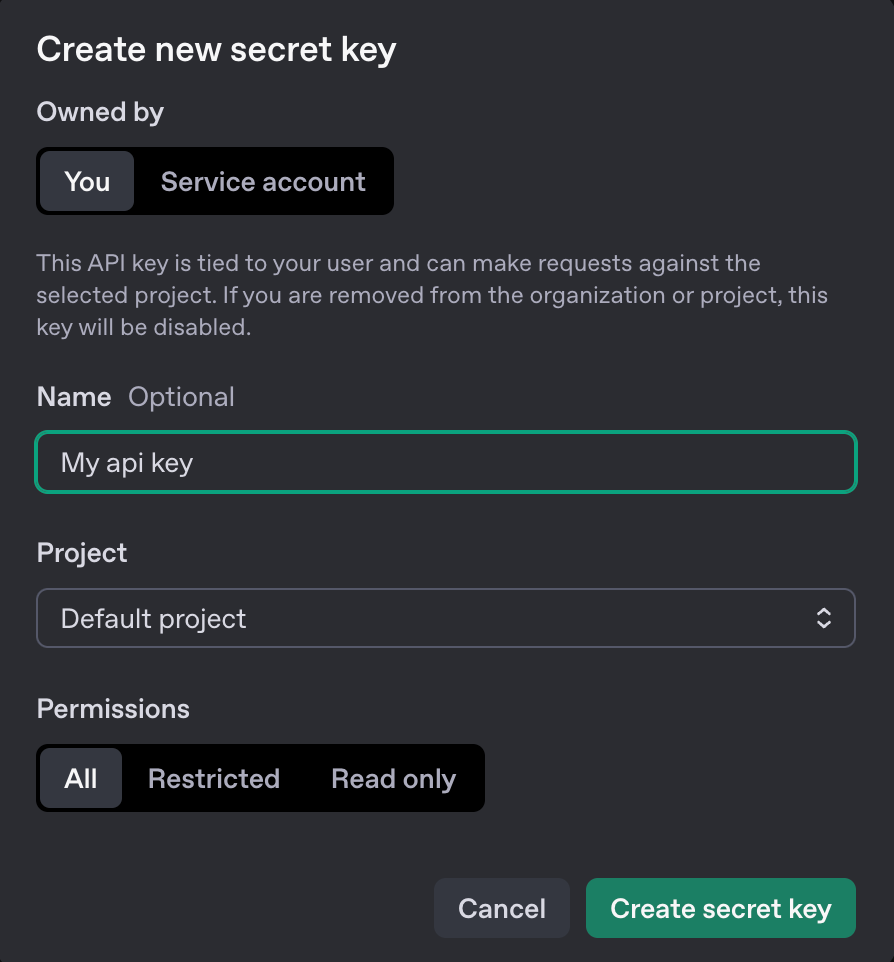
- Copy the API key into the respective field on Make.com and hit Save.

- Select a GPT assistant.

- Keep Role set to User.
- The Message is where you’ll add your prompt to instruct the GPT to craft your content.
Note that you’ll craft the content for your page in a few stages, so we’ll create more OpenAI modules after this too.
For the first one, we’ll ask GPT to create a structured outline.
Important: You can adapt the prompt below based on however you’d like your content to be formatted and written. In this case, we’re working with recipes, so the outline will have a specific format.
Generate a structured outline based on the following details:
Topic: [Insert Topic from Google Sheets]
Target Keywords: [Insert Keywords from Google Sheets]
The outline should include:
- An engaging introduction (1-2 short paragraphs)
- Briefly introduce the dish (what makes it great, when to make it)
- Mention any unique ingredients or flavors
- Relate it to a specific audience (e.g., busy professionals, health-conscious eaters)
Key Recipe Details
- Prep Time: XX minutes
- Cook Time: XX minutes
- Servings: XX servings
- Difficulty: Easy/Medium/Hard
Ingredients List
- Clearly formatted list of ingredients
- Include specific measurements
- Suggest possible substitutions (if relevant)
Step-by-Step Instructions
- Numbered steps for clarity
- Keep steps concise and beginner-friendly
- Add extra tips (e.g., “For extra crispiness, bake at 425°F instead of 400°F.”)
Storage & Serving Suggestions
- How to store leftovers
- Best ways to serve the dish
Nutritional Information (if applicable)
- Calories per serving
- Key nutrients (protein, carbs, fats)
Final Tips & Variations
- Ideas for ingredient swaps
- Ways to customize the recipe
Make sure the outline is clear, engaging, and easy to follow.
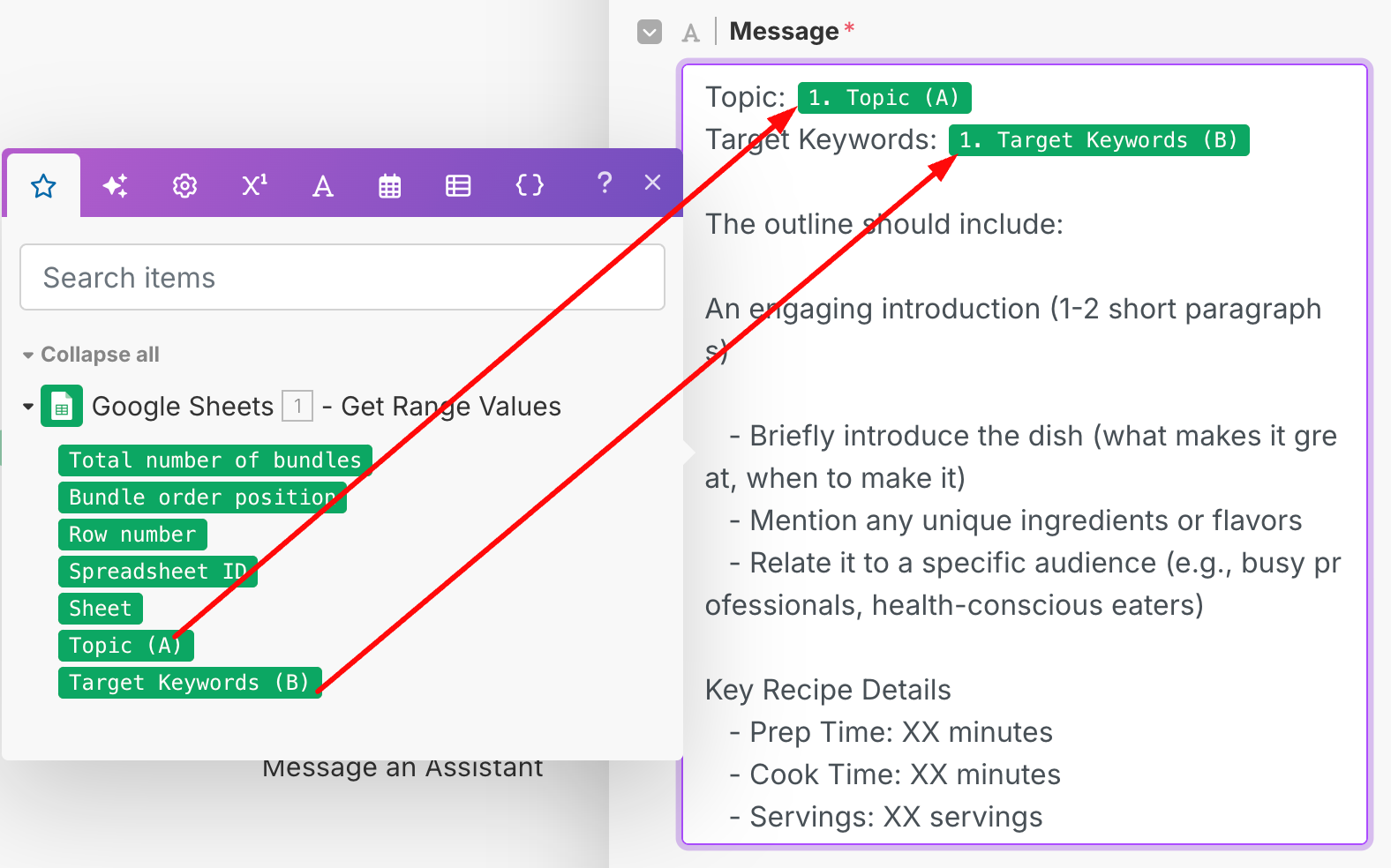
- Click Save and right click on this module to Rename it to something like “Outline”. This will make it easier in the following steps where we’ll create one more OpenAI module.
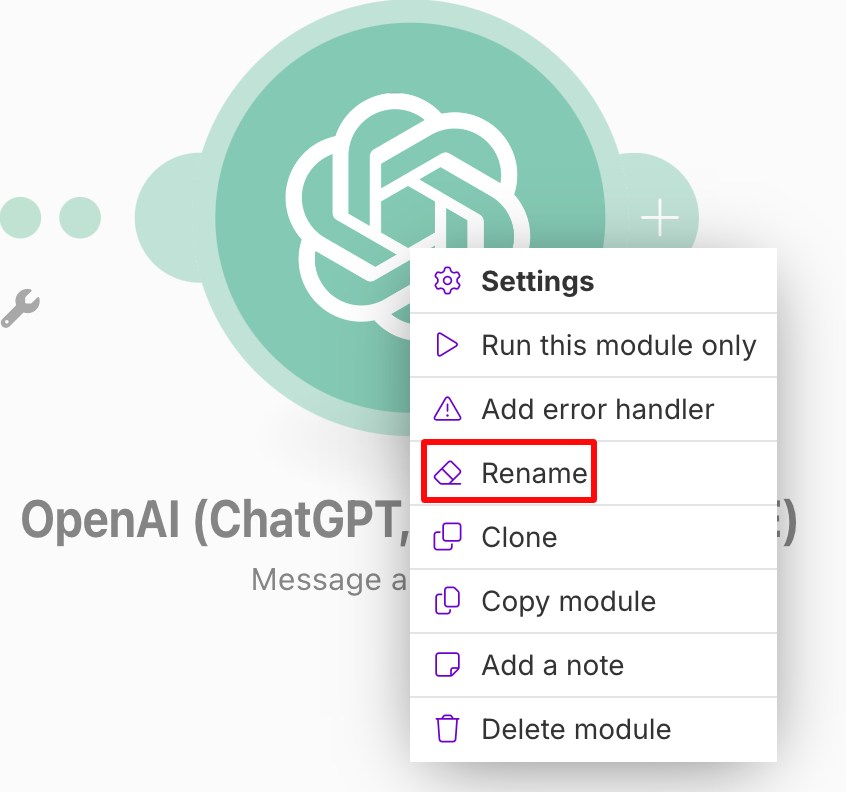
- So that you don’t have to keep creating a new OpenAI connection, right click on the “Outline” module, and clone it.

- Rename this to “Content Generator”.
The purpose of this second module is to expand the outline result from the first module, into a fully written page.
- Open the module and now replace the Message (prompt) with something like this.
Write a complete, well-formatted recipe page based on the following structured outline:
[Insert AI-Generated Outline from Outline Module]Requirements:
- Tone: Friendly and informative, but not too informal.
- Use the following keywords naturally throughout the page: [Insert Target Keywords from Sheet]
- Format with H2 for main sections (e.g., Ingredients, Instructions, Storage, etc.)
- Use bullet points for ingredients and numbered steps for instructions.
- Make sure each step is clear, concise, and easy to follow.
- Provide useful tips and variations to make the recipe versatile and unique.
? Recipe Name
? Prep Time: XX mins | ?️ Servings: X | ? Cook Time: XX mins
Ingredients
- Ingredient 1 (measurement)
- Ingredient 2 (measurement)
- Ingredient 3 (measurement)
Instructions
- Step one…
- Step two…
- Step three…
Tips & Variations
- Optional customization ideas…
- How to make it vegetarian, gluten-free, etc.
Make the content structured, engaging, and SEO-friendly.
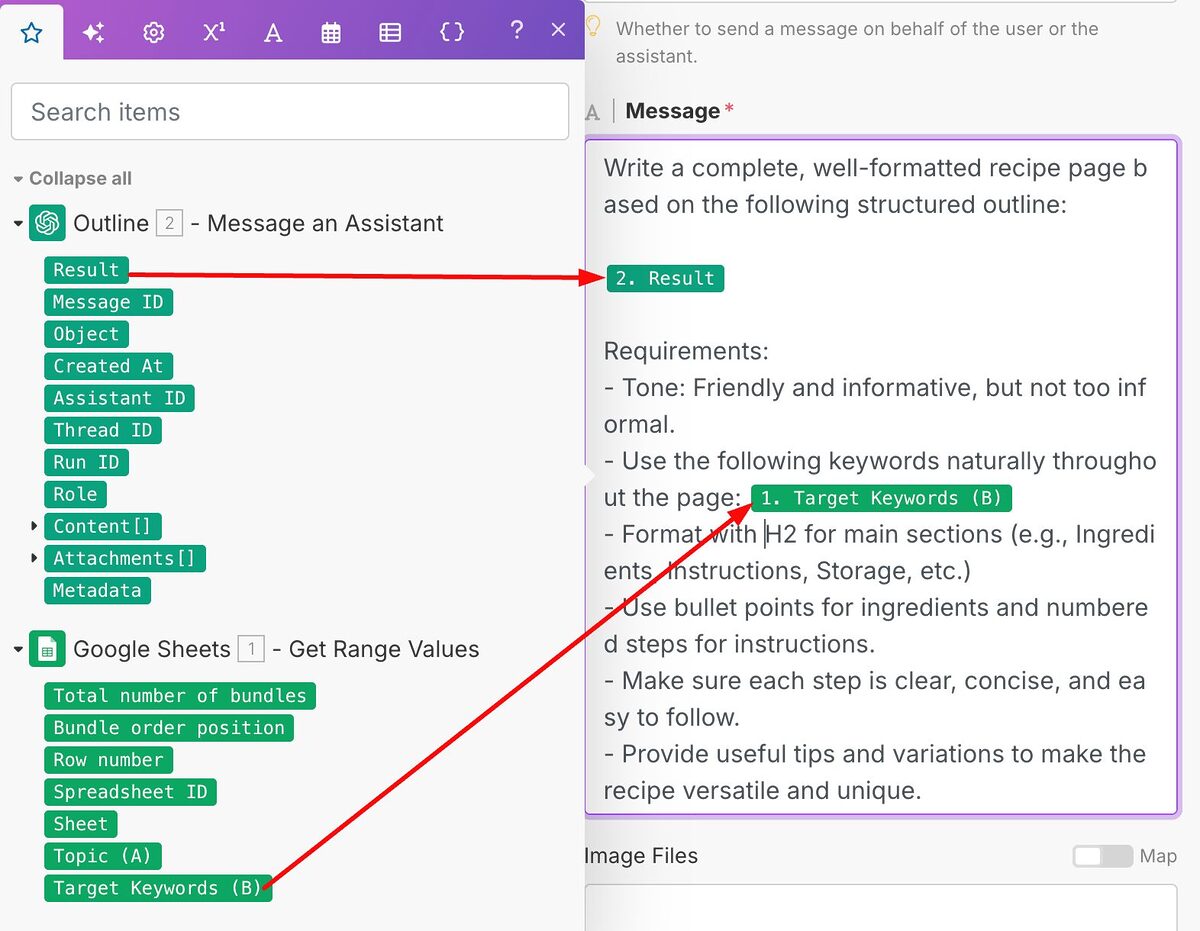
- Click Save, and Clone this module
Saving the Output to Google Docs
Now, we could ask GPT to add in the resultant content back into the spreadsheet, but that’s not ideal considering it’s generating a full article.
So instead, we’ll get it to save each article into a Google Doc.
- Add a Google Docs module, select Create a Document and make sure it’s connected to your Google account.
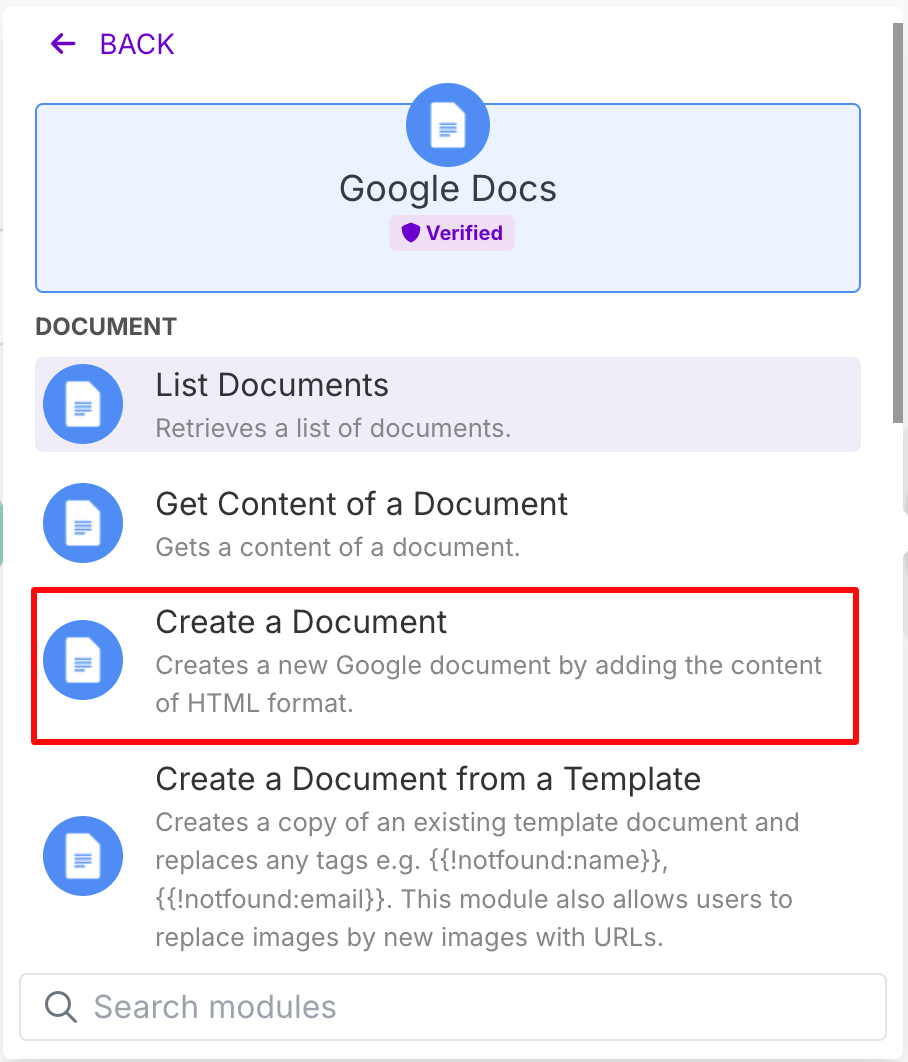
- Set the Name of the document to Topic (from the sheet) and Content to the Result (from the Content Generator OpenAI module).

- Select the location where you want the documents to be stored and hit Save.

- Click Run once to execute the automation.

- The documents are stored in the respective folder on your Google drive.
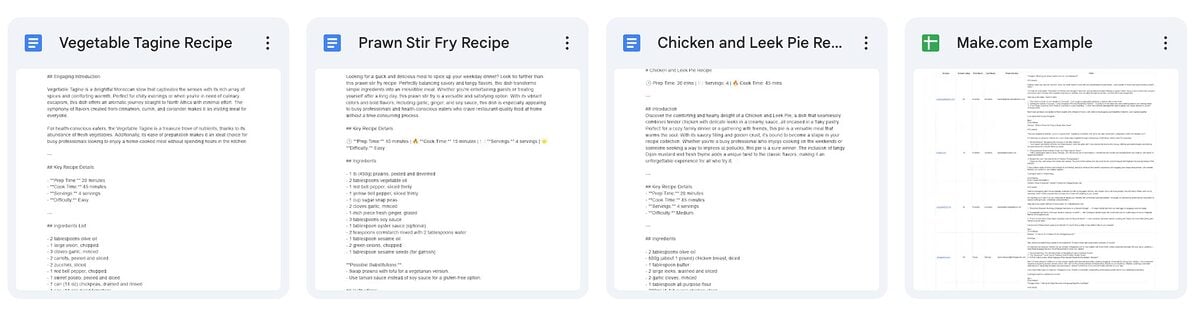
And here’s an example of the content:

- If the results aren’t quite what you’re looking for, adapt the prompts according to what you’d like to be changed.
For example, I’ve decided I want the recipes to be formatted so that it’s easy to upload to a website.
Let’s update the prompt to Content Generator module (edits are in italics):
Write a complete, well-formatted recipe page based on the following structured outline:
[Insert AI-Generated Outline from Outline Module]
Requirements:
- Tone: Friendly and informative, but not too informal.
- Make sure you follow eloquence formulas: Dialectic, Double Entendre with Anastomosis, Enumeration with Distinction, Epizeuxis with Exemplum, Future Casting with Anaphora, Gnome, Positio Finalem with Concession in a question, Tricolor with Antanagoge
- Use the following keywords naturally throughout the page: [Insert Target Keywords from Sheet]